
Written and edited by Chandan Bhattacharjee
Editor, IndiFinance | MBA, Economics (Hons.) | Indian | Writes & Teaches Finance, Marketing, Business, Technology & AI
Independent editorial. No paid placements.
Every Diwali, your family repeats the same line: ‘Beta, gold is the safest investment.’
And every year you nod, buy a coin or two, feel responsible, and tuck it into the locker.
But here’s the uncomfortable question nobody asks over dinner: when it comes to sovereign gold bonds vs physical gold, are you actually building wealth — or just collecting shiny metal that sits in a vault doing absolutely nothing?

With 24-carat gold hovering around ₹15,000 per gram in 2026 — roughly ₹1.5 lakh for just 10 grams — every gold decision now involves serious money. And there’s a twist this year that quietly flips the old advice on its head. Let’s settle this properly, the way an older sibling would explain it over chai, before your next big purchase.
The 2026 plot twist nobody told you about
For years, every finance blog (including ours) said the same thing: skip physical gold, buy Sovereign Gold Bonds instead. Cleaner, cheaper, pays you interest. Solid advice.
Here’s the catch. The government has stopped issuing new Sovereign Gold Bonds. The last fresh tranche was way back in February 2024 (SGB 2023-24 Series IV). The RBI has not announced any issuance calendar for the new financial year, and the scheme is effectively paused — reportedly because it became too expensive for the government as gold prices kept climbing.
So if you walk into your bank tomorrow asking to buy a brand-new SGB at the official issue price, you’ll be politely turned away. That option simply isn’t on the table right now.
Translation: the classic ‘sovereign gold bonds vs physical gold’ debate isn’t dead — but the rules of the game have changed, and most people haven’t updated their thinking.
Don’t worry. You still have a way into SGBs (through the secondary market), and we’ll get to exactly how. But first, let’s make sure you actually understand both options.
What are Sovereign Gold Bonds, really?
Think of an SGB as a government IOU that’s pegged to the price of gold.
Each bond represents 1 gram of gold. You don’t get a physical coin — you hold it in your demat account or as a certificate. When gold’s price rises, your bond’s value rises with it. When it’s time to cash out, you’re paid in rupees based on the prevailing gold rate.
What made SGBs special:
- 2.5% interest every year, paid twice a year, on top of any rise in gold’s price. Physical gold pays you nothing.
- No GST, no making charges, no storage headache.
- 8-year maturity, with an exit option from year 5.
- A sovereign guarantee — backed by the Government of India, so default risk is effectively nil.
Imagine Ravi, a 28-year-old software engineer in Bengaluru earning ₹80,000 a month. He put ₹1 lakh into SGBs a few years ago. He earns ₹2,500 a year in interest like clockwork — and his investment also rode the gold rally. No locker, no insurance, no worrying whether a thief or a flood would wipe him out.
That’s the appeal. Now let’s look at what physical gold quietly costs you.
What physical gold actually costs you (the hidden bill)
When your aunt buys a gold bangle, she sees one number on the tag. But you’re paying for at least four things stacked on top of each other.
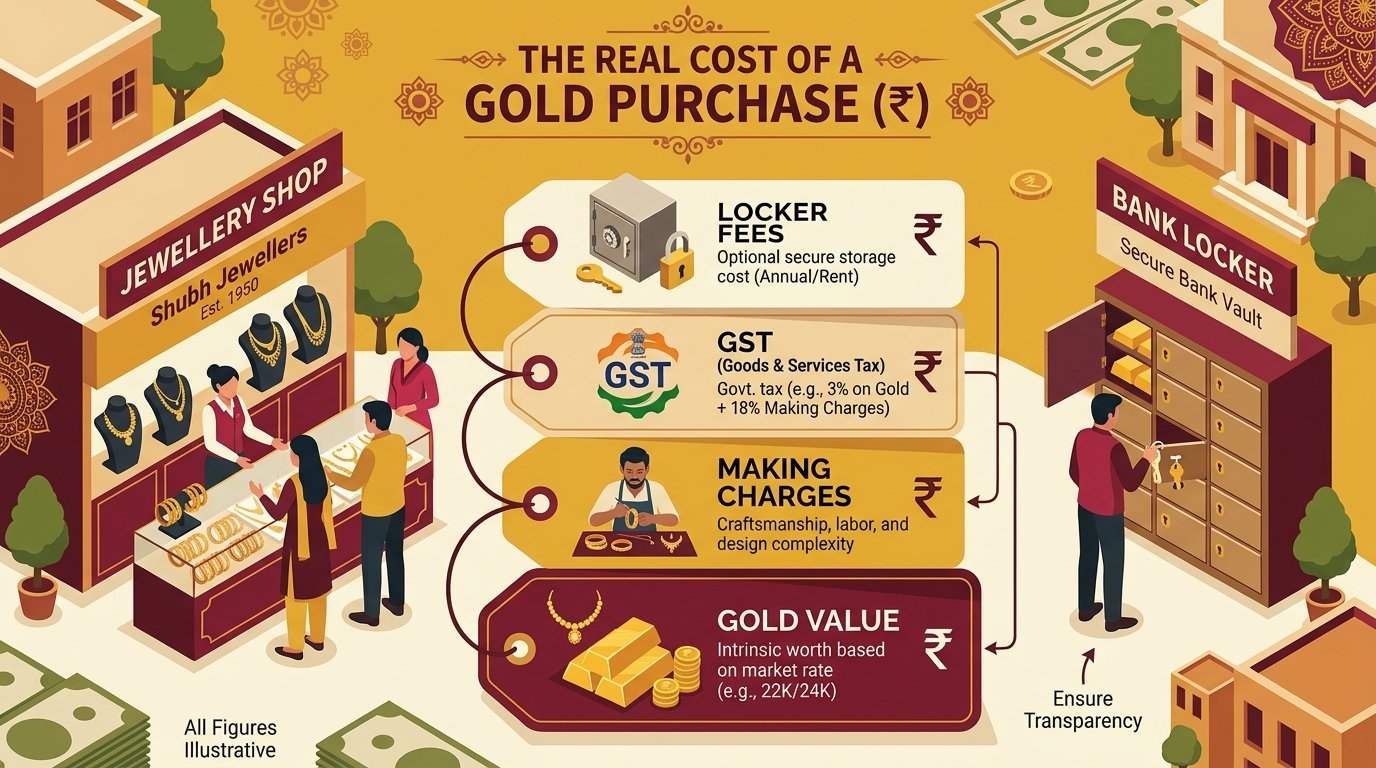
- The gold itself — fair enough, that’s the metal.
- 3% GST — applied on the purchase. On a ₹1 lakh purchase, that’s ₹3,000 gone instantly.
- Making charges — for jewellery, this runs anywhere from 8% to 25%. On ₹1 lakh of jewellery, that’s ₹8,000 to ₹25,000 you’ll likely never recover when you sell.
- Storage and safety — a bank locker can cost ₹1,500 to ₹5,000+ a year, plus the constant low-grade anxiety of keeping it at home.
Then there’s the resale sting. Take that bangle to a jeweller and you’ll often get the value of the gold content only — minus making charges, sometimes minus a ‘wastage’ deduction, and frequently at 22-carat rates rather than 24-carat. Coins and bars resell better than jewellery, but you still lose the GST and any premium you paid.
Picture Meera, a 32-year-old teacher in Pune, who buys a ₹1 lakh gold necklace. After 3% GST and 15% making charges, she has effectively spent around ₹1,18,000 to own about ₹1 lakh of actual gold. The metal has to climb 18% just for her to break even. Gold is a great asset — but jewellery is a terrible investment vehicle.
Sovereign Gold Bonds vs physical gold: the honest head-to-head
Here’s the side-by-side, no sugar-coating.
| Factor | Sovereign Gold Bonds (SGB) | Physical Gold (coins/jewellery) |
|---|---|---|
| Extra cost to buy | None (on primary issue). Small premium/discount on secondary market. | 3% GST + 8-25% making charges on jewellery |
| Earns interest? | Yes — 2.5% per year | No — zero |
| Storage | Digital, in demat. No risk, no rent. | Locker or home; theft and safety risk |
| Purity worries | None — tracks 999 pure gold | Real risk; needs hallmark checking |
| Liquidity | Listed on NSE/BSE; sellable anytime | Sell to jeweller, often at a haircut |
| Availability in 2026 | Secondary market only — no new issues | Available everywhere, anytime |
| Emotional/utility value | None — you can’t wear it | High — weddings, gifting, tradition |
On almost every pure-investment metric, SGBs win. Physical gold’s edge is emotional and practical: you can wear it to a wedding, gift it, or pledge it for a quick loan. A bond can’t do any of that.
The tax angle nobody explains properly
This is where 2026 quietly rewrote the script, so read slowly.
For people who bought SGBs directly from the RBI and hold them to the full 8-year maturity, the deal is still beautiful: the capital gains are completely tax-free. The yearly 2.5% interest is taxable as per your income slab, but the big gain from gold’s rise? Exempt. That’s an unmatched perk.
But here’s the Budget 2026 twist: if you buy SGBs from the secondary market now — which is your only option, since new issues have stopped — those capital gains are no longer tax-free, even if you hold to maturity. They’ll be taxed as long-term capital gains. Many people still assume buying old bonds on the exchange and holding gets them the exemption. It doesn’t anymore.
And physical gold? If you hold it for more than 24 months, long-term capital gains are taxed at 12.5% (without indexation). Sell sooner and the gains get added to your income and taxed at your slab rate.
So the tax scoreboard in 2026 looks roughly like this:
- Old SGBs you already hold from the primary issue, kept to maturity — best case, gains tax-free. Keep them.
- New secondary-market SGB purchase — gains taxable, but you still get the 2.5% interest and zero storage hassle.
- Physical gold — 12.5% LTCG after 24 months, plus all those upfront costs.
So which one is the smarter buy for YOU?
There’s no single winner. There’s a winner for your situation.
Buy (or keep) SGBs if: you want gold purely as an investment, you don’t need to physically hold or wear it, and you value the extra 2.5% yearly income plus zero storage stress. If you already own primary-issue SGBs, hold them to maturity — that tax-free gain is gold-plated.
- The Future of Cryptocurrency in India: Hype, Hope & Hard Truths Crypto in India is legal but heavily taxed and tightly watched. Here's the honest 2026 picture—tax…
- Stop Ignoring This Market: How to Invest in Indian Commodity Markets in 2026 The Indian commodity market is booming — 21 lakh retail users, record gold prices, and landmark…
Buy physical gold if: the gold has a real-life job — a wedding, gifting, religious occasion, or as a back-up asset you can pledge for an emergency loan. In that case, prefer coins or bars (low making charges) over heavy jewellery, and always insist on hallmarked gold.
Most balanced Indian families end up doing both: a little physical gold for life and tradition, and the bulk of their gold ‘investment’ in a paper or digital form that actually works harder.
How to actually buy SGBs in 2026
Since fresh tranches have stopped, the door now is the secondary market.
- Open or use an existing demat and trading account.
- Search for listed SGB series on the NSE or BSE (they trade in the cash segment).
- Check the live price — older bonds can trade at a small premium or discount to the actual gold value, so compare before buying.
- Place your order like any stock. The units land in your demat.
Two honest cautions: secondary-market SGBs can be thinly traded, so the buy/sell spread may be wider than you’d like, and remember the tax exemption no longer applies to these purchases. You’re buying them for the gold exposure and the remaining 2.5% interest, not the old tax magic.
What about gold ETFs and digital gold?
With SGBs paused, two cousins are worth knowing.
Gold ETFs and gold mutual funds let you buy gold-linked units through your demat or a regular SIP — no making charges, no storage, highly liquid. Great for disciplined monthly investing. They don’t pay interest like SGBs, but they’re the cleanest ‘paper gold’ option still freely available.
You can even run a small gold SIP the same way you’d run an equity SIP — ₹500 or ₹1,000 a month — and slowly build a gold cushion without buying a single coin.
Digital gold (via apps and wallets) is convenient but carries a 3% GST and isn’t regulated by SEBI the way ETFs are, so treat it as a small convenience holding, not your core gold strategy.

Common mistakes to avoid
Even smart savers trip on these. Don’t be one of them.
- Treating jewellery as an investment. Those making charges quietly eat 8-25% of your money. Wear it, love it — just don’t count it as wealth-building.
- Assuming you can still buy new SGBs at issue price. You can’t. Anyone telling you to ‘wait for the next tranche’ is working with old information.
- Buying secondary-market SGBs expecting tax-free gains. That exemption is gone for these. Budget 2026 closed that door.
- Putting 50% of your savings in gold. Gold is a hedge, not an engine. Most planners suggest keeping it to roughly 5-15% of your portfolio, with the rest in equity, debt and an emergency fund.
- Ignoring purity. Always demand hallmarked (BIS) gold. An unhallmarked ‘great deal’ usually isn’t.
- Skipping the bill. No GST invoice means trouble at resale and zero proof of purity.
Your 7-day gold action plan
Reading is nice. Doing is better. Here’s a plan you can finish this week.
- Day 1: Add up all the gold you already own and roughly value it at today’s rate (~₹15,000/gram for 24-carat). You may own more than you think.
- Day 2: Calculate what % of your total savings is in gold. Over 15%? You’re probably overweight.
- Day 3: If you hold primary-issue SGBs, note their maturity dates and resolve to hold them to maturity for the tax-free gain.
- Day 4: Decide your purpose for any new gold — investment or life-event. This single answer picks your product for you.
- Day 5: If it’s investment, compare a gold ETF/SIP versus a secondary-market SGB on your trading app.
- Day 6: If it’s for a wedding or gifting, price hallmarked coins at two jewellers and compare making charges. Negotiate.
- Day 7: Set up a small automatic gold SIP (even ₹500/month) so you stop buying gold emotionally at festival peaks and start buying it steadily.
Frequently asked questions
Can I still buy new Sovereign Gold Bonds in 2026?
No. The RBI has stopped issuing fresh tranches — the last one was in February 2024, and no new issuance calendar has been announced. You can only buy existing SGBs through the secondary market on the NSE or BSE using a demat account.
Are Sovereign Gold Bonds tax-free?
Only partly, and it now depends on how you bought them. If you bought directly from the RBI’s primary issue and hold to the 8-year maturity, the capital gains are tax-free. But for SGBs bought on the secondary market, Budget 2026 made the gains taxable even if you hold to maturity. The 2.5% annual interest is always taxable at your income slab.
Is physical gold a good investment in India?
Physical gold is excellent for tradition, gifting and emergencies, but a weak pure investment because of 3% GST, 8-25% making charges on jewellery, storage costs and a resale haircut. For wealth-building, paper gold like ETFs usually serves you better.
What is better right now, SGB or gold ETF?
For a fresh investment in 2026, a gold ETF or gold SIP is the most convenient regulated option since new SGBs aren’t being issued. A secondary-market SGB still gives you 2.5% interest, which ETFs don’t — but with wider price spreads and taxable gains. Match the choice to whether you want simplicity (ETF) or that extra interest (SGB).

How much of my money should be in gold?
A common guideline is 5-15% of your overall portfolio. Gold cushions you against inflation and market shocks, but it doesn’t compound like equity, so it should support your portfolio — not dominate it.
Can I take a loan against Sovereign Gold Bonds?
Yes. Banks accept SGBs as collateral for loans, similar to a gold loan against physical gold, with the loan-to-value following RBI norms. It’s one more reason SGBs hold their own against a coin in a locker.
The bottom line
Gold isn’t going anywhere in the Indian heart, and it shouldn’t. But owning gold and investing in gold are two different skills.
In the old debate of sovereign gold bonds vs physical gold, the bonds quietly won on cost, convenience and that lovely 2.5% interest. In 2026, with new issues paused, the smart move is simpler than ever: keep the SGBs you already own, use ETFs or SIPs for fresh gold investing, and buy physical gold only when it has a real job to do — a wedding, a gift, a festival.
Do that, and your gold finally starts working as hard as you do — instead of just gleaming in a drawer.
Ready to go deeper? Explore our guides on starting a gold SIP, building a balanced portfolio, and smart tax-saving investments — and make this the year your money grows up.
This article is for educational purposes only and is not personalised financial advice. Gold prices, tax rules and bond availability change — please verify current figures and consult a SEBI-registered advisor before investing.