Written and edited by Chandan Bhattacharjee
Editor, IndiFinance | MBA, Economics (Hons.) | Indian | Writes & Teaches Finance, Marketing, Business, Technology & AI
Independent editorial. No paid placements.
You’ve been SIPping every month, watching your demat app religiously, and maybe even trying your luck with stocks. But there’s a whole market right under your nose that most Indian investors completely ignore. A market where the price of your gold bangles, the petrol in your tank, and the silver in your grandmother’s cupboard gets decided every single day. That’s the Indian commodity market. And in 2026, it’s on fire — and you need to be paying attention. Invest in Indian Commodity Market and gather knowledge on that
Why Commodity Markets Are Impossible to Ignore Right Now
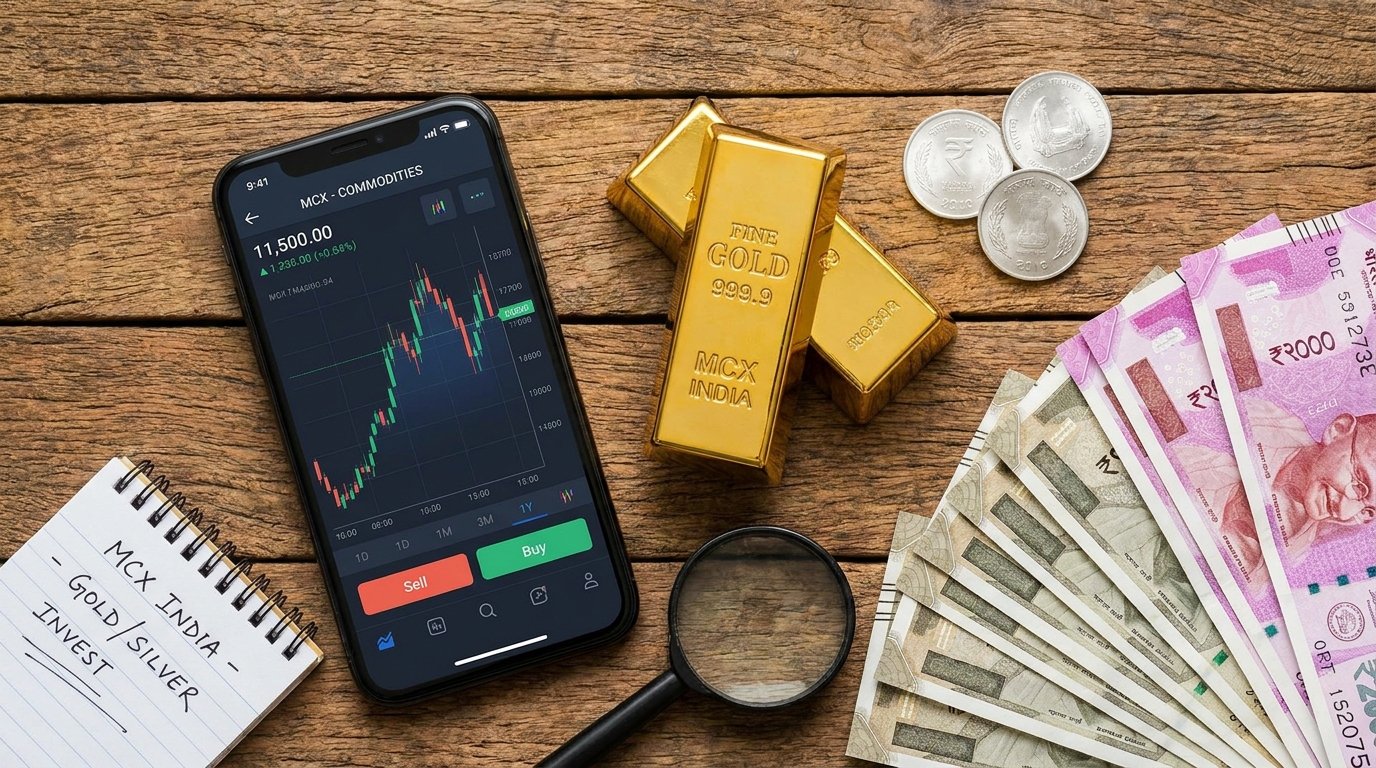
Retail participation on MCX — India’s largest commodity exchange — recently crossed 21 lakh registered users. SEBI has just proposed sweeping reforms that will reshape how traders operate. Gold touched ₹1 lakh per 10 grams for the first time in Indian history. Silver futures corrected by a jaw-dropping ₹35,000 per kg in a single session after one government announcement. And crude oil is swinging wildly in response to Middle East geopolitical tensions that show no sign of easing.
This isn’t abstract, far-away finance theory. These price moves affect your car loan EMI, your monthly grocery bill, the cost of your next Dhanteras gold purchase, and even the electricity tariffs your business pays. If you want to seriously invest in the Indian commodity market — or simply understand it well enough to protect your wealth — 2026 is the year to start. Here’s everything you need to know, explained simply, without jargon.
MCX 101: How the Indian Commodity Market Actually Works
India’s primary commodity exchange is MCX (Multi Commodity Exchange of India), regulated by SEBI. There’s also NCDEX (National Commodity and Derivatives Exchange), which specialises in agricultural commodities like chana, soybean, and mustard seed. Think of MCX the way you think of BSE or NSE — except instead of company shares, you’re trading physical goods.
The two main instruments you’ll encounter are:
- Futures contracts: An agreement to buy or sell a specific quantity of a commodity at a fixed price on a future expiry date. Both parties are legally obligated to honour the contract.
- Options contracts: The buyer pays a premium upfront for the right (not the obligation) to buy or sell. Your maximum loss as a buyer is capped at the premium. This is what most new retail participants are gravitating to in 2026.
Here’s what you need to understand about contract mechanics before you put a single rupee in:
- Lot sizes: Every commodity trades in fixed quantities. MCX Gold = 1 kg per contract; Gold Mini = 100 grams; CRUDEOILM (Crude Oil Mini) = 10 barrels; Silver = 30 kg.
- Trading hours: MCX trades from 9:00 AM to 11:30 PM IST — the extended evening session aligns with international markets opening in London and New York.
- Settlement: Contracts can be cash-settled or physically delivered, depending on the commodity and your position at expiry.
- Margin: You pay only a fraction of the contract’s full value as margin. This is leverage — it amplifies both gains and losses.
To start trading, you need a commodity trading account (separate from your equity demat account) with a SEBI-registered broker like Zerodha, Angel One, Motilal Oswal, or ICICI Direct. Activation is quick — but understanding what you’re trading is non-negotiable first.
SEBI’s May 2026 Agri-Commodity Overhaul — What Every Trader Must Know
SEBI released a landmark consultation paper in May 2026 that is reshaping the commodity derivatives landscape for every active participant. If you plan to invest in the Indian commodity market, especially in agricultural derivatives, this is required reading.
The headline change: SEBI has proposed to double the client-level position limits for agricultural derivatives. The existing broad-category limit stood at 1% of the deliverable supply for any given agri-commodity. The proposed revision pushes this to 2%. This means traders can now hold significantly larger positions in futures contracts for commodities like chana, soybean, mustard seed, or castor seed without triggering a regulatory breach.
For a trader like Priya, a 32-year-old commodities enthusiast from Pune who has been cautiously trading soybean futures, this effectively doubles her permitted exposure. It signals SEBI’s growing confidence in the market’s depth, liquidity, and institutional maturity. For Indian farmers and agri-businesses using these markets to hedge crop price risk, wider limits offer better price discovery and more effective hedging.
SEBI’s New 3-Tier Penalty Regime — Read This Before Your Next Trade
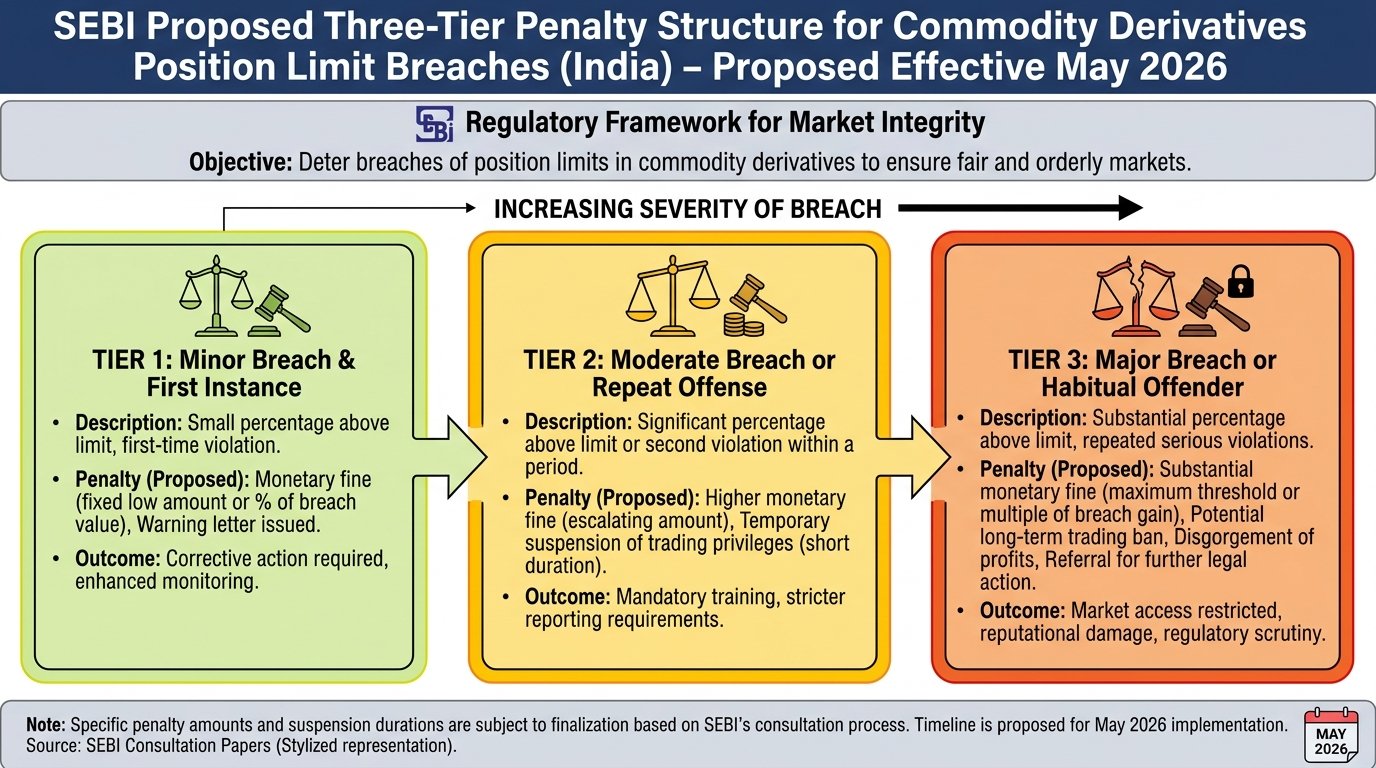
But larger freedom comes with sharper accountability. The same May 2026 consultation paper introduces a structured, proportional penalty regime for position limit breaches. Here’s how the tiers break down:
| Tier | Breach Description | Proposed Penalty |
|---|---|---|
| Tier 1 — Minor / Accidental | Small overshoot corrected quickly; no market impact or intent | Capped at ₹10,000 |
| Tier 2 — Moderate / Negligent | Recurring breaches; inadequate internal position monitoring | Graduated penalty linked to breach size and frequency |
| Tier 3 — Willful Manipulation | Deliberate cornering of market; clear intent to manipulate prices | Severe financial penalties + potential trading suspension |
The framework is thoughtfully designed — it doesn’t punish a genuine one-time miscalculation the same way it punishes intentional market abuse. But the message is clear: monitor your open positions in real time against SEBI-prescribed Market-Wide Position Limits (MWPL) and client-level limits. Ignorance will not be a valid defence before the regulator.
The Gold and Silver Earthquake: How the 15% Import Duty Changed Everything
Here’s the story that shook every commodity market participant in early 2026 — and it’s a masterclass in why domestic policy matters just as much as global price action.
The Indian government raised the import duty on gold and silver from 9% to 15% — a sharp 6 percentage-point increase that caught many traders off guard. The market reaction was swift and brutal. MCX silver futures corrected by ₹35,000 per kg in the aftermath — one of the most severe single-event corrections the exchange has witnessed.
Why was the reaction so dramatic? Here’s the chain of events:
- Higher import duties make gold and silver more expensive to bring into India, squeezing the inflow of imported bullion.
- In the near term, this dampens demand expectations — importers defer orders, jewellers hold back purchases, and industrial buyers scramble to renegotiate.
- Traders who held large long positions in silver futures faced brutal mark-to-market losses overnight — with no time to exit cleanly.
- Rupee volatility triggered by the announcement further compounded the move, since bullion is dollar-denominated globally but priced in rupees on MCX.
The lesson is simple but critical: when you invest in the Indian commodity market, you are never just playing global spot prices. Budget announcements, import duty revisions, GST changes, and export restrictions are all first-order price drivers. Keep one eye on the Finance Ministry and one eye on Bloomberg — and set up news alerts for both.
Silver’s Identity Crisis: Safe Haven Metal or Industrial Powerhouse in 2026?
For generations, Indian households bought silver during Dhanteras, stored it as a hedge against bad times, and thought of it as gold’s more affordable sibling. That image is rapidly becoming outdated — and understanding what silver actually is in 2026 could be the edge that makes your commodity strategy work.
Silver is increasingly trading as a pure industrial metal, with three structural mega-trends driving relentless demand:
- AI Data Center Infrastructure: Silver is indispensable in electrical contacts, semiconductor manufacturing, and printed circuit boards. Every new AI data center built anywhere in the world — from Texas to Telangana — is a source of silver demand that simply did not exist five years ago. As AI capex accelerates globally, this demand is non-discretionary and non-seasonal.
- Green Energy and Solar Panels: Silver paste is a core component of photovoltaic solar cells. As India aggressively scales its solar capacity — targeting hundreds of gigawatts over the coming decade — domestic industrial silver demand is rising structurally.
- Electric Vehicle Manufacturing: EVs use significantly more silver per vehicle than internal combustion engine cars — for battery management contacts, sensors, and charging systems. India’s EV push under the government’s production-linked incentive schemes is adding a genuine domestic demand tailwind here.
The result? Silver’s traditional price correlation with gold is breaking down. On some days, silver tracks copper like a pure industrial commodity. On others, it surges alongside gold during a safe-haven flight. This dual personality makes silver one of the most intellectually interesting — and operationally volatile — commodities to track in 2026.
The practical implication: don’t buy silver just because it’s cheaper than gold. Understand that when AI capital expenditure slows, when solar installation rates disappoint, or when EV adoption hits a speed bump, silver can correct hard and fast — even if gold remains stable. Price your thesis accordingly.
A Real-World Crude Oil Trade: MCX CRUDEOILM in 2026
Let’s get out of theory and into practice. Meet Arjun, a 29-year-old data analyst in Chennai, who wants to make his first commodity trade on MCX. He’s been tracking crude oil because it affects his company’s logistics costs and he wants to understand if he can hedge or profit from price moves.
He looks at the CRUDEOILM contract — MCX Crude Oil Mini — which is trading at approximately ₹8,400 per barrel in May 2026, elevated significantly by ongoing Middle East geopolitical tensions affecting key shipping corridors and supply chain confidence globally.
- Lot size: 10 barrels per contract
- Full contract value: ₹8,400 × 10 = ₹84,000
- Margin required (~10–12%): approximately ₹8,400 to ₹10,080 upfront
Arjun reads credible reports of escalating tensions affecting a key Middle East shipping lane. He buys one lot of CRUDEOILM at ₹8,400. Three days later, prices rise to ₹8,700 — a ₹300 per barrel move driven by supply disruption fears.
His profit: ₹300 × 10 barrels = ₹3,000 on a ~₹10,000 margin outlay. That’s roughly a 30% return in three days. Now flip the scenario: tensions de-escalate faster than expected and prices fall to ₹8,100. His loss is also ₹3,000 — 30% of his margin, gone in three days without any fault in his reasoning.
This is the power and the peril of commodity leverage, illustrated plainly. And here’s the often-missed detail: since crude oil is globally priced in US dollars, the USD/INR exchange rate directly affects your MCX price. If the rupee weakens by ₹1 against the dollar while global WTI prices hold steady, your MCX crude oil position still moves higher — and vice versa. Commodity trading in India is, by nature, also a currency trade. Track the dollar. Always.
Gold Three Ways: Physical Gold vs. SGB vs. Electronic Gold Receipt (EGR)
Most Indian households default to physical gold. There’s nothing wrong with that emotionally — but financially, in 2026, there are better options. Let’s compare your three main choices honestly.
| Feature | Physical Gold | Sovereign Gold Bond (SGB) | Electronic Gold Receipt (EGR) |
|---|---|---|---|
| Where to buy | Jeweller / bank | RBI via banks and exchanges | NSE / BSE (SEBI-regulated) |
| Making charges | 8–20% on jewellery | None | None |
| Annual interest | None | 2.5% per annum | None |
| Storage cost | Locker rental fee | Zero | Zero |
| Purity guarantee | Varies by hallmark | 999 fine gold equivalent | 999 fine gold, vault-verified |
| Tax on gains | LTCG after 2 years | Tax-free at maturity (8 years) | Short-term or long-term CGT |
| Liquidity | Moderate (sell to jeweller) | Limited (secondary market thin) | High — exchange-traded daily |
| Minimum quantity | Typically 1 gram | 1 gram (minimum 1 unit) | 1 gram |
Electronic Gold Receipts deserve special attention in 2026. EGRs are SEBI-regulated digital certificates backed by physical gold stored in SEBI-accredited vaults. You can buy and sell them on NSE or BSE exactly like a stock — starting from 1 gram, with complete transparency on purity (999 fine gold, guaranteed) and zero storage hassle or locker fees.
Think of someone like Meera, a 35-year-old schoolteacher in Nagpur who loves gold as a savings vehicle but has always resented jewellery making charges (which can eat up 15% of her investment on Day 1) and the anxiety of a bank locker. EGRs eliminate both pain points entirely. The one trade-off compared to Sovereign Gold Bonds: EGRs don’t pay the 2.5% annual interest that SGBs offer. But for pure gold price exposure with maximum flexibility and liquidity, EGRs are arguably the most intelligent gold vehicle in 2026 for an active investor.
- Sovereign Gold Bonds vs Physical Gold: Which Wins in 2026? Gold is near ₹15,000 a gram and the old SGB advice just changed. Here's an honest,…
- The Future of Cryptocurrency in India: Hype, Hope & Hard Truths Crypto in India is legal but heavily taxed and tightly watched. Here's the honest 2026 picture—tax…
The Retail Options Explosion: 21 Lakh Users and Counting
A few years ago, commodity options were the exclusive domain of large institutional hedgers and seasoned derivatives traders. In 2026, that picture has completely reversed.
MCX now has over 21 lakh registered retail participants, and a rapidly growing share of them are entering the market through commodity options rather than futures. Here’s why the shift is happening:
- Defined, capped risk: When you buy a call or put option, your maximum possible loss is the premium you paid upfront. No midnight margin calls, no forced liquidations, no nasty surprises.
- Lower capital barrier: An MCX Gold call option at a strike price of ₹95,000 per 10 grams might cost just ₹800–1,200 as premium for a one-month contract — versus ₹20,000+ in margin for a Gold Mini futures contract.
- Strategic flexibility: Options let you structure trades to profit from rising markets, falling markets, or even a market that barely moves — depending on the strategy.
| Futures Contract | Options Contract (Buyer) | |
|---|---|---|
| Maximum loss | Unlimited (to the buyer) | Limited to premium paid |
| Margin required | High (full SEBI-mandated upfront margin) | Lower (premium only for option buyers) |
| Complexity | Moderate | Moderate to high |
| Best suited for | Hedgers and experienced directional traders | Beginners and defined-risk directional bets |
If you’re just starting to invest in the Indian commodity market, exploring commodity options with a small, defined premium is a significantly smarter and psychologically easier entry point than diving straight into leveraged futures contracts where losses can exceed your initial capital.

Margin, Leverage, and Risk Management: The Part Nobody Puts in the Brochure
This is the unsexy but absolutely critical section. Every single thing above is meaningless if you don’t manage risk properly. Commodity markets can be brutally unforgiving to the underprepared.
SEBI mandates upfront margin collection before any commodity trade is executed. Your broker must collect SPAN margin plus Exposure margin before your order hits the exchange. There is no grace period, no credit trading, no exceptions. This rule exists to protect you and the market’s integrity.
Understanding VSR (Volatility Scan Range)
SEBI uses a Volatility Scan Range (VSR) framework to dynamically recalculate margin requirements based on current market volatility. During high-volatility periods — a Middle East conflict escalation, a surprise Union Budget announcement, a drought affecting agri-commodity prices — the VSR expands and MCX automatically hikes margin requirements. Your ₹15,000 margin for a Gold Mini contract today could become ₹22,000 tomorrow if volatility spikes sharply.
The practical implication: always maintain a cash buffer in your trading account well above the minimum required margin. Getting force-liquidated at the worst possible price because your margin fell ₹500 short is one of the most painful and avoidable mistakes in commodity trading. Keep at least 25–30% extra buffer at all times.
The Non-Negotiable Risk Rules
- Never risk more than 2% of your total trading capital on any single trade. This is the most important rule in all of trading, not just commodities.
- Set your stop-loss before entering the trade — not after. Once you’re in and watching the price move against you, your judgement is compromised by emotion.
- Avoid trading just before major macro events — RBI policy meetings, US Federal Reserve decisions, OPEC+ production announcements — unless you have a specific, well-researched edge.
- Track USD/INR daily. Every ₹1 move in the exchange rate materially shifts the rupee price of all dollar-denominated commodities on MCX, including gold, silver, and crude oil.
- Calculate your break-even price before every trade. Factor in brokerage, exchange transaction charges, STT on options, and GST on brokerage. On high-frequency strategies, these costs can consume 30–40% of gross profits. Know your real numbers.
New Frontiers: Electricity Derivatives and Coal-Linked Products
The Indian commodity market is expanding well beyond gold, silver, and crude oil — and early movers in new instrument categories historically find the most opportunity.
MCX has been actively developing electricity derivatives — financial contracts linked to domestic power prices. In a country that experiences dramatic electricity price spikes during summer peak-demand crises, electricity derivatives could become an enormously valuable hedging tool for industrial consumers, large commercial enterprises, and power trading companies. Watch this space closely through 2026 and into 2027.
Additionally, MCX’s broader ecosystem is expanding into coal-linked exchange operations — directly relevant to India’s still coal-heavy energy mix and to the large industrial sector that needs price certainty for fuel procurement planning. These products are nascent today, but the trajectory is clear: the Indian commodity market of 2030 will look very different from — and significantly broader than — the one you’re entering now.
Things Nobody Tells You About Commodity Trading in India
The commodity market doesn’t care about your conviction. It responds to price action, macro events, and margin levels — in that order.
Myth 1: Commodity trading is only for big institutional players. Completely false. With mini contracts like CRUDEOILM (10 barrels) or Gold Mini (100 grams), you can get meaningful market exposure with ₹10,000–15,000 in margin. The market is accessible — it simply demands education before participation.
Myth 2: Gold always goes up over time, so you can’t lose. Not in commodity futures, you can’t count on this. Import duty hikes, a strengthening rupee, coordinated central bank selling, or falling global risk sentiment can push MCX gold down sharply — and quickly. The 2026 silver correction proved that policy risk can override even structural trends.
Myth 3: You need to monitor markets all day, every day. MCX closes at 11:30 PM. Set price alerts on your broker app. Use limit orders and stop-losses, not market orders during volatile sessions. A clear, pre-planned strategy beats constant screen time every single time.
The emotional trap that destroys new traders: Commodity prices are violently news-driven. A single geopolitical announcement, a weather-related crop report from Brazil, or an unexpected central bank decision can move prices 3–5% in minutes. The instinct to panic-sell at the bottom or panic-buy at the top is almost universal among new participants. Build a plan before you enter. Commit to it even when it feels uncomfortable. That discipline is where real profits are made.
Your 2026 Getting-Started Checklist: How to Invest in Indian Commodity Markets
Ready to take the first step? Here is a practical, actionable guide to getting started safely and correctly:
- Open a commodity trading account: Choose a SEBI-registered broker — Zerodha, Angel One, Motilal Oswal, or ICICI Direct are all solid options. Explicitly request activation of the commodity segment during account opening; it is separate from equity trading and requires a distinct activation step.
- Complete full KYC: Aadhaar, PAN, and bank account linking are mandatory. Ensure your bank account supports RTGS/NEFT for quick margin transfers — slow transfers during volatile sessions can cost you dearly.
- Study contract specifications on MCX: Visit mcxindia.com. For every commodity you intend to trade, understand the lot size, initial margin requirement, contract expiry dates, last trading day, and delivery settlement rules. Never trade a contract whose specifications you haven’t read.
- Understand Market-Wide Position Limits (MWPL): SEBI caps the total open interest permitted across all participants for each commodity. As a commodity approaches its MWPL, new positions may be restricted and existing ones potentially reduced. Check MWPL levels before entering any large trade.
- Spend two to four weeks in observation mode first: Track MCX gold or CRUDEOILM prices daily without trading. Note exactly which news events cause which price moves. Keep a simple journal. This deliberate observation period is worth more than any paid course.
- Track USD/INR every trading day: Bookmark the RBI reference rate page. This single data point is the most important macro indicator for pricing every dollar-denominated commodity on MCX — gold, silver, crude oil, copper, and natural gas all respond to currency moves.
- Paper trade before using real capital: Several brokers offer simulated trading environments. Run your strategy on paper for at least two to three weeks. If you can’t make money on paper, you won’t make money with real money — but you will lose it faster.
- Start with micro exposure on mini contracts: Your first real trade should be a single lot of Gold Mini (100 grams) or CRUDEOILM (10 barrels) — the smallest meaningful exposure available on MCX. Scale your position size only after demonstrating consistent profitability, never before.
Frequently Asked Questions
Is commodity trading safe for beginners in India?
Commodity trading carries meaningfully higher risk than mutual funds or bank FDs, primarily because of leverage and rapid, news-driven price volatility. That said, beginning with commodity options — where your maximum loss is capped at the premium paid — or trading single lots of mini contracts with strict stop-losses makes the risk manageable for educated, disciplined beginners. The operative word throughout is educated. Never trade an instrument whose mechanics and risks you cannot explain in plain language.
What is the minimum amount needed to start trading on MCX in 2026?
You can open a commodity trading account and begin with as little as ₹10,000–15,000 in initial margin for mini contracts like CRUDEOILM or Gold Mini. However, always maintain a buffer well above the minimum required margin — SEBI’s Volatility Scan Range framework means margin requirements can be hiked automatically during volatile sessions, and running too close to the minimum risks forced liquidation at the worst possible time.
How does the USD/INR exchange rate affect MCX commodity prices?
Gold, silver, crude oil, copper, and most major commodities traded on MCX are globally benchmarked in US dollars. When the Indian rupee weakens against the dollar, domestic MCX prices rise even if international spot prices are completely unchanged. A ₹1 move in the USD/INR rate can shift MCX crude oil by ₹80–100 per barrel in isolation. For serious commodity traders, the foreign exchange market is not a secondary concern — it is a primary one.
What are Electronic Gold Receipts (EGRs) and are they better than holding physical gold?
EGRs are SEBI-regulated digital certificates backed by physical 999-purity gold stored in SEBI-accredited vaults. They trade on NSE and BSE exactly like stocks — you can buy from 1 gram, sell intraday if needed, and take physical delivery if you prefer. There are no jewellery making charges, no storage fees, and no purity ambiguity. For investors who want pure gold price exposure without the cost drag or security concerns of physical ownership, EGRs are arguably the most rational choice in 2026. The one edge that Sovereign Gold Bonds retain: a guaranteed 2.5% annual interest that EGRs do not offer.
What happens if I accidentally breach position limits on MCX?
Under SEBI’s proposed May 2026 3-tier penalty regime, a minor accidental breach that is corrected quickly and has no market impact may be penalised at a capped amount of just ₹10,000. Moderate or recurring breaches attract proportional graduated penalties. Willful manipulation — deliberately attempting to corner a commodity’s market — invites severe financial penalties and a potential trading suspension. Track your open positions in real time against both client-level limits and the broader Market-Wide Position Limit for every commodity you trade.
Why is silver so volatile in 2026, and is it worth investing in?
Silver’s volatility in 2026 stems from its unique dual identity as both a traditional safe-haven asset and an industrial metal critical to AI infrastructure, solar panels, and EV manufacturing. This means its price can be driven simultaneously by investor sentiment (like gold) and by global industrial capex cycles (like copper), creating unpredictable swings. Silver is absolutely worth having in a diversified commodity portfolio — but position it with full awareness of both demand drivers, not just as a cheap alternative to gold. Use Silver Mini contracts on MCX to start, and consider silver ETFs for longer-term, lower-leverage exposure.
The Bottom Line: Your Commodity Market Journey Starts Today
The Indian commodity market in 2026 is not the obscure, institutional-only arena your parents walked past. It is a SEBI-regulated, technologically sophisticated, and rapidly democratising ecosystem — one with 21 lakh retail participants, landmark new regulatory frameworks, gold instruments like EGRs that eliminate centuries-old inefficiencies, and new product categories from electricity derivatives to coal-linked contracts that reflect India’s evolving economic ambitions.
Yes, there is complexity here. Yes, there is real risk — leveraged, news-driven, and unforgiving of carelessness. But staying ignorant of commodity markets is also a form of risk. When import duties spike and silver corrects ₹35,000 per kg overnight, when crude oil surges on a geopolitical headline and adds thousands to your business costs, when gold touches ₹1 lakh and you’re holding jewellery bought at 15% making charges — understanding how to invest in the Indian commodity market is what separates reactive financial decision-making from truly informed wealth management.
Start small. Learn relentlessly. Trade with a plan and the discipline to stick to it. And when you’re ready to go deeper, explore IndiFinance’s guides on smart gold investment strategies, building a risk management framework for your portfolio, and getting started with investing in India from scratch. Every rupee you truly understand is a rupee you can confidently put to work.