Written and edited by Chandan Bhattacharjee
Editor, IndiFinance | MBA, Economics (Hons.) | Indian | Writes & Teaches Finance, Marketing, Business, Technology & AI
Independent editorial. No paid placements.

The importance of macroeconomics is simple: inflation, interest rates, the rupee and economic growth decide what your salary can buy, how much EMI you pay, whether your FD is actually growing and how safe your job is. You don’t need to become an economist. You need to understand five big numbers well enough to make better money decisions.
Most people ignore these numbers because they sound like news for bankers. But they show up every month, in your grocery bill, your loan statement and your appraisal letter. This guide shows exactly how, with rupee calculations you can check yourself.
What is macroeconomics, in plain words?
Microeconomics is about one household or one business. How you spend your salary. How a kirana store prices its atta.
Macroeconomics is about the whole country at once. How fast prices are rising everywhere. How much the RBI charges banks to borrow. How much the entire economy is producing. What one rupee is worth against other currencies.
Think of it this way. Your personal budget is the boat. Macroeconomics is the river. You can row well, but if the river is flowing against you, you need to know that before you plan the trip.
The 5 numbers that quietly run your financial life
Here is a quick map before we go into each one.
| Big number | What it means | Where it hits you | Where to check it |
|---|---|---|---|
| Inflation (CPI) | How fast prices rise across the country | Groceries, rent, school fees, real value of savings | mospi.gov.in, rbi.org.in |
| Repo rate | The rate at which RBI lends to banks | Home loan and car loan EMIs, FD rates | rbi.org.in (monetary policy statements) |
| GDP growth | How fast the economy is producing more | Hiring, appraisals, business sales, freelance demand | mospi.gov.in |
| Rupee exchange rate | What one rupee buys in other currencies | Petrol, phones, foreign education, foreign travel | rbi.org.in (reference rates) |
| Fiscal deficit and Budget | How much the government spends beyond what it earns | Taxes, subsidies, government borrowing, interest rates | indiabudget.gov.in |
Now let’s see what each one actually does to your money.
How inflation affects your savings (the silent pay cut)
Inflation is the one number every Indian should understand first. When prices rise faster than your income or your returns, you are getting poorer even if your bank balance is going up.
The FD that looks safe but is shrinking
Say Arjun, a 45-year-old government employee in Bhubaneswar, keeps ₹5 lakh in an FD. For this example, assume the FD pays 7% a year and inflation is running at 6%.
- Interest earned: ₹35,000 a year
- If his income falls in a 30% tax bracket (check current slabs on incometax.gov.in), tax on that interest is about ₹10,500
- What he actually keeps: ₹24,500, which is a post-tax return of 4.9%
- To simply keep up with 6% inflation, his ₹5 lakh needed to grow by ₹30,000
So Arjun ends the year with more rupees but about ₹5,500 less buying power. His statement says profit. His kitchen says loss.
This is why the question is never just ‘what rate does this pay?’ The real question is what is left after tax and after inflation? That number is called the real return, and macroeconomics is what teaches you to look for it.
The expense that doubles while you’re not watching
Say Priya, 35, runs her Hyderabad household on ₹50,000 a month. If prices rise at an assumed 6% a year, the same lifestyle will cost about ₹89,500 a month in 10 years.
That one calculation changes how much she needs for retirement, her child’s education and even her emergency fund. Anyone who plans using today’s prices is planning for a life that won’t exist.
A marketer’s view: how brands hide inflation
Companies know Indians notice price tags. So when costs rise, many don’t raise the price. They shrink the product. The ₹10 biscuit pack stays ₹10 but has fewer grams. The shampoo bottle gets a slimmer shape.
This is called shrinkflation. The fix is boring but effective: compare price per gram or per ml, which is printed on most packs in small type, not the MRP.
Repo rate and home loan EMI: why RBI decisions reach your bank account
When the RBI raises its repo rate, borrowing gets costlier for banks. Banks pass this on. If you have a floating-rate loan, your rate usually goes up within a few months. When the RBI cuts, the reverse happens, though banks are often slower to pass on cuts than hikes.
Worked example: a 0.5% rise on a ₹40 lakh home loan
Say Rohit and Aditi, a newly married couple in Pune, take a ₹40 lakh home loan for 20 years. Assume the rate starts at 8.5% and later rises to 9%.
- EMI at 8.5%: about ₹34,713
- EMI at 9%: about ₹35,989
- Extra cost if the EMI goes up: about ₹1,276 a month, roughly ₹3 lakh over 20 years
That sounds manageable. But here’s the trap most borrowers never notice.
The tenure trap banks don’t advertise
Many banks don’t raise your EMI when rates rise. They quietly stretch your loan tenure instead, because a higher EMI triggers complaints and a longer tenure doesn’t.
In the same example, if the EMI stays at ₹34,713 and the bank extends the loan instead, the 20-year loan becomes about 22 years and 3 months. That’s roughly 27 extra EMIs, or about ₹9.4 lakh more paid in total.
Compare that with about ₹3 lakh extra if you accept the higher EMI. Same rate hike. Three times the damage, just because nobody checked.
Decision rule: whenever you hear that the RBI has changed the repo rate, log in to your loan account within a month and check two things: your new interest rate and your remaining tenure. If the tenure has jumped, ask your bank about increasing the EMI or making a part-prepayment instead. You can read more in our guide on floating vs fixed home loans.
The other side: FD rates and savers
Rate cycles help some people and hurt others. When rates rise, borrowers pay more but new FDs pay better. When rates fall, EMIs ease but retired parents living on FD interest see their income drop.
If your parents depend on FD interest, a falling-rate period is exactly when they need a plan, not a surprise at renewal time.
GDP growth and jobs in India: why the economy decides your appraisal
GDP growth sounds abstract until you connect it to hiring. When the economy grows strongly, companies expand, hire and give better hikes. When it slows, the first things to go are new hiring, bonuses and freelance budgets.
How a slowdown reaches three different people
- Karthik, an IT professional in Coimbatore: his company’s overseas clients cut spending. Hiring freezes, appraisals shrink, and layoff rumours start.
- Meera, a freelance designer in Kochi: her small business clients delay projects and pay late. Her income becomes lumpy.
- Imran, who runs a kirana store in Lucknow: customers switch to smaller packs and cheaper brands. His sales volume holds, but his margin thins.
None of them can control GDP. But each of them can see the signals early, in news about slowing growth, weak demand or companies cutting forecasts, and act before it hits.
Decision rule: when growth is slowing, this is not the year to take a big new loan on the assumption of a fat hike. It is the year to build up your emergency fund to cover at least six months of expenses.
A marketer’s view: booms sell credit
When the economy feels good, ads for credit cards, personal loans and ‘zero-cost EMI’ deals get louder. Brands know people spend more when they feel confident about next year’s income.
- What Is EPFO? Your Complete, No-Jargon Guide to PF, Pension and Withdrawals EPFO runs the PF account cut from your salary every month. Learn how contributions are split,…
- Dollar vs Rupee in 2026: How a Weak Rupee Quietly Eats Your Salary The dollar rupee rate impact isn't just news for traders. It quietly raises your petrol bill,…
- Cybersecurity in India: 11 Brutal Truths Before You Lose Your Savings From UPI scams to fake job links on WhatsApp, cybersecurity in India has become a daily…
- How AI Can Make You Financially Strong Written and edited by Chandan Bhattacharjee Editor, IndiFinance | MBA, ... Read more
The problem is that EMIs are fixed, but next year’s income is not. A sensible habit: before signing any EMI, ask whether you could still pay it if your income stayed flat for a full year.
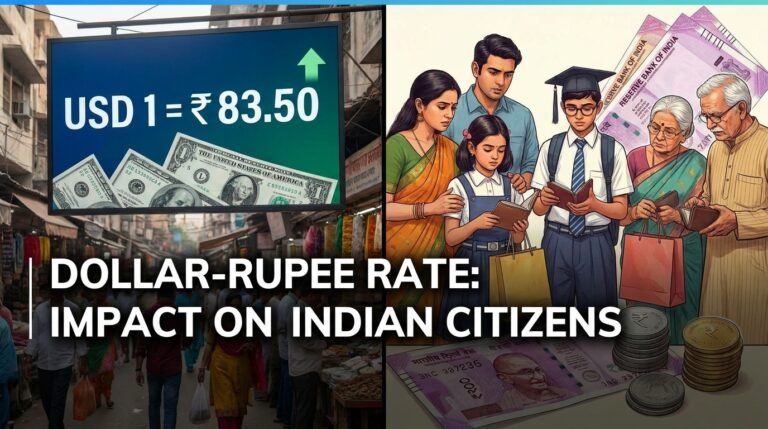
Rupee depreciation: impact on the common man
India imports a large share of its crude oil, electronics and many raw materials. When the rupee weakens against other currencies, all of these cost more in rupees, even if their global price hasn’t moved.
You see it in petrol prices, phone prices and anything with imported parts. You feel it most if you have any goal priced in a foreign currency.
Worked example: studying abroad
Say Sneha in Guwahati is planning a master’s degree abroad. Today the total cost works out to ₹30 lakh. The fees are fixed in the foreign currency, not in rupees.
If the rupee weakens 10% against that currency before she pays, the same course costs about ₹33 lakh. She hasn’t changed universities. The economy changed the price.
Decision rule: for any goal priced in a foreign currency, such as overseas education, foreign travel or an imported machine for your business, add a buffer of at least 10 to 15% to your rupee estimate. Don’t plan with today’s exchange rate as if it’s fixed.
Fiscal deficit and the Budget: why government finances are your finances
The fiscal deficit is the gap between what the government spends and what it earns, mainly through taxes. The government fills this gap by borrowing.
Why should you care? Three reasons.
- Taxes: every Budget can change income tax slabs, deductions, capital gains rules and GST. These directly change your take-home pay and your investment returns.
- Interest rates: heavy government borrowing competes with everyone else for money, which can keep interest rates higher.
- Inflation: large spending financed by borrowing can push prices up if the economy can’t produce enough to match.
Understanding this also makes you a sharper citizen. When any party promises free benefits or big tax cuts, the useful question is not whether it sounds good. It is where the money will come from: higher taxes elsewhere, cuts to other spending, or more borrowing that someone repays later. You don’t need a political view to ask that question. You just need basic macroeconomics.
Why is macroeconomics important for a common man? The honest summary
Here is how the pieces connect in a normal Indian life:
- Inflation decides whether your savings are growing or shrinking.
- The repo rate decides your EMI, your loan tenure and your parents’ FD income.
- GDP growth decides how secure your job, hike or business sales are.
- The rupee decides the cost of fuel, gadgets and any foreign goal.
- The Budget decides your tax bill and much of what you get back from the government.
Once you see these links, financial news stops being noise. A headline about an RBI policy or a CPI number becomes a reminder to check something specific in your own money.
How to track macroeconomics in 15 minutes a month
You don’t need to read economics textbooks. A small routine is enough.
- Once a month, note the latest CPI inflation figure. Compare it with the post-tax return on your FDs and savings account. If inflation is higher, your money is losing value.
- After every RBI monetary policy announcement, check your loan account. Look at your rate and remaining tenure, not just the EMI.
- Every quarter, glance at GDP and job market news. If things are slowing, top up your emergency fund and go slow on new loans.
- On Budget day, read only the personal-finance changes. Tax slabs, deductions and capital gains rules. Then check how they apply to you on incometax.gov.in.
- If you have a foreign-currency goal, track the rupee rate every few months and adjust your savings target.
That’s it. Five checks, a few minutes each.
What macroeconomics will not do for you
A word of caution. Understanding the economy helps you plan. It does not help you predict the stock market.
Plenty of people read that inflation is rising and sell all their mutual funds, or hear that growth is slowing and stop their SIPs. Markets often move before the news, and sometimes in the opposite direction. Experts with full-time research teams get these calls wrong regularly.
Use macroeconomics to manage your loans, your emergency fund, your tax planning and your real returns. Don’t use it to time the market. For long-term goals, a disciplined SIP usually beats a clever forecast. Our guide to real returns after inflation explains how to judge investments on what’s actually left in your hand.
Frequently asked questions
What is the difference between microeconomics and macroeconomics?
Microeconomics studies individual decisions, like how a family budgets or how a shop sets prices. Macroeconomics studies the whole economy: national inflation, interest rates, GDP, employment and the currency. For your personal finances, micro is how you row the boat and macro is the river you’re rowing in.
How does the repo rate affect my home loan EMI?
Most floating-rate home loans in India are linked to an external benchmark such as the repo rate. When RBI raises it, your loan rate usually rises after the next reset, and either your EMI goes up or your tenure gets longer. Always check both, because a longer tenure can cost far more in total interest than a slightly higher EMI.
Which economic numbers should a salaried person track?
Three are enough for most people: CPI inflation, the RBI repo rate and Budget changes to income tax. Inflation tells you if your savings and salary hikes are keeping up, the repo rate affects your loans and deposits, and the Budget changes your take-home pay. Check official figures on mospi.gov.in, rbi.org.in and incometax.gov.in.
Is a 6% salary hike good if inflation is also 6%?
Not really. If your salary rises 6% and prices rise 6%, your buying power stays the same, so your real hike is close to zero. After a higher tax outgo, it can even be slightly negative. Judge every hike, and every investment, against the current inflation rate.
Can I learn macroeconomics without a commerce background?
Yes. For personal finance you need concepts, not equations: what inflation, interest rates, GDP and exchange rates are, and how each affects your money. Reading RBI’s policy summaries and the personal-finance section of Budget coverage for a few months will teach you more practical macroeconomics than most textbooks.
The bottom line
The importance of macroeconomics isn’t academic. It is the difference between an FD that grows and one that quietly shrinks, between a loan that ends on time and one that runs two extra years, and between being caught off guard by a slowdown and being ready for it.
You don’t have to predict the economy. You only have to notice it, and then check your own numbers. Fifteen minutes a month is enough to start.
If you want to put this into practice, start with our guides on building an emergency fund and calculating real returns after inflation.
This article is for educational purposes only and is not investment, tax or legal advice. Please check current rules and rates on official websites before acting.