Written and edited by Chandan Bhattacharjee
Editor, IndiFinance | MBA, Economics (Hons.) | Indian | Writes & Teaches Finance, Marketing, Business, Technology & AI
Independent editorial. No paid placements.

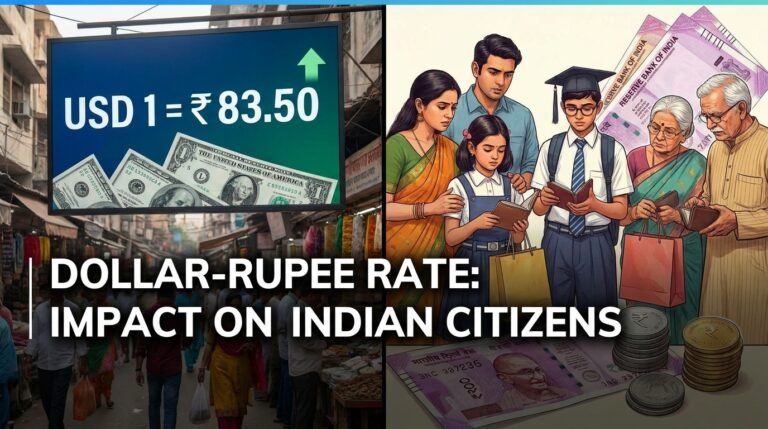
Short answer: a rupee near 97 per dollar won’t change your salary or your SIP tomorrow. But it quietly makes everything with a dollar price inside it costlier: foreign fees, trips abroad, imported gadgets, gold and crude oil. At the same time, it puts more rupees in the pockets of NRI families, exporters and freelancers paid in dollars. That is the real rupee fall impact on common man: not one big shock, but many small leaks across your budget.
The Economic Times reported on 11 October 2026 that the rupee closed at 96.73 per dollar on Friday, very close to its all-time closing low of 96.82, and has lost about 7% this year. On Saturday, RBI tightened the rules on forex derivative trades to cool speculative demand for dollars.
Here is what changed, who gets hurt, who gains, and what you should (and shouldn’t) do about it.
What did RBI change, and does it affect you?
According to the ET report, RBI did four main things:
- Lowered transaction limits on forex derivative contracts and asked for stricter documentation.
- Stopped users from rebooking rupee forex derivative contracts that were cancelled after the new directions were issued.
- Brought in a new Foreign Exchange Risk Reserve (FERR): for derivative contracts above $2 million, banks must keep 20% of the rupee equivalent in cash.
- Opened a special window to meet the daily dollar needs of three public sector oil companies: BPCL, HPCL and IndianOil.
In plain English: big companies and traders were buying dollar contracts, some to protect themselves and some as a bet that the rupee would fall further. That extra dollar demand was pushing the rupee down. RBI has made those bets costlier and more paperwork-heavy. The oil company window means their huge daily dollar purchases won’t hit the open market all at once.
So does this rule touch your forex card or UPI?
Almost certainly not. These rules cover forex derivative contracts, the hedging deals used by importers, exporters and banks. They are not about your forex card, your international debit card, or the fees you send to a foreign university. Rules for individuals sending money abroad are separate, so check with your bank if you have a transfer coming up.
What matters for you is the indirect effect. If RBI manages to steady the rupee, the pressure on your costs eases. If it doesn’t, those costs keep creeping up.
Why is the rupee falling in 2026?
ET points to two reasons: foreign capital leaving India, and rising fuel prices.
When foreign investors sell Indian shares and bonds, they convert their rupees back into dollars. And because India imports most of its crude oil and pays for it in dollars, costlier oil means oil companies need more dollars every day.
Think of it like Tatkal tickets. When far more people want dollars than are selling them, the price of a dollar goes up. A rising dollar is just another way of saying a falling rupee.
A weaker rupee is not automatically a disaster. It helps exporters and brings in more rupees for every dollar earned. The trouble is speed. A fast fall makes planning hard and pushes up the cost of imports before anyone can adjust.
How a falling rupee hits your monthly budget
Here is a simple rule: if a product or service has a dollar price hidden inside it, expect it to get costlier. Some items feel it immediately, others with a lag.
| Area | Why it is affected | What you may notice |
|---|---|---|
| Studying abroad | Fees and living costs are in dollars | Your rupee budget grows with every move |
| Foreign trips | Hotels, flights and spending are priced in foreign currency | Same trip, bigger card bill |
| Phones, laptops, electronics | Many parts and finished products are imported | Price revisions on new stock and new models |
| Gold | Gold is priced globally in dollars | Rupee gold price rises even if global gold is flat |
| Fuel and transport | Crude oil is bought in dollars | Pressure on fuel, freight and delivery costs |
| Dollar subscriptions | Software, cloud tools and courses billed in dollars | Higher monthly card charges |
Studying abroad: the biggest hit
This is where the fall hurts most, because the amounts are large.
Say Ananya, a 23-year-old engineering graduate in Pune, has a US master’s admission. Fees plus living costs come to about $40,000 for the first year. Her family started planning when the rupee was around 90. Here is how her bill changes:
| Rupee per dollar | Cost of $40,000 | Extra compared to ₹90 |
|---|---|---|
| ₹90 | ₹36,00,000 | — |
| ₹95 | ₹38,00,000 | ₹2,00,000 |
| ₹97 | ₹38,80,000 | ₹2,80,000 |
| ₹100 | ₹40,00,000 | ₹4,00,000 |
The rule of thumb: for a $40,000 bill, every ₹1 fall in the rupee adds ₹40,000 to the cost. If her education loan was sanctioned on the old estimate, the family has to fill a ₹2.8 lakh gap from savings. That is before the second year’s fees.
Foreign trips: same holiday, bigger bill
Say Karthik and his wife in Coimbatore have planned a December holiday abroad with a budget of $2,500. At ₹90, that was ₹2,25,000. At ₹97, it is ₹2,42,500. That is ₹17,500 more for exactly the same trip.
On top of that comes the markup on your card or forex card. Banks and card providers often apply an exchange rate slightly worse than the market rate, plus fees. On a big trip, even a small markup adds up, so compare the total cost, not just the headline rate.
Phones, laptops and the Diwali sale
Most phones and laptops sold in India use imported parts, even when assembled here. Brands rarely change prices overnight. They usually adjust when new stock arrives or a new model launches.
For illustration, if a brand passes on the full 7% fall, an ₹80,000 laptop could become about ₹85,600 at the next price revision. But this is exactly the fear that festive sales use to rush you. If you need a laptop for work, buy it at a good price. If you don’t, a currency headline is not a reason to buy.
Fuel, gold and the slow creep in prices
Costlier crude in rupee terms puts pressure on oil companies. Pump prices in India don’t always move immediately, because government and oil company decisions play a role. But higher import costs eventually show up somewhere, in fuel, in transport fares, or in what it costs to move vegetables from the farm to your local market.
Gold is more direct. Since gold is priced in dollars globally, a falling rupee pushes up the rupee price of gold even when global gold prices don’t move. Parents feel richer about the jewellery in the locker. Families buying for a wedding this season pay more.
Will your home loan EMI go up?
Not directly. Your floating-rate home loan is linked to a benchmark like the repo rate, not to the rupee. The indirect link: a weak rupee can push up prices of imported goods, which adds to inflation. RBI watches inflation when deciding interest rates. If inflation rises, rate cuts can take longer, so EMIs may not fall as quickly as you hoped. Follow RBI’s policy announcements on rbi.org.in rather than guessing.
Who actually gains when the rupee falls?
A falling rupee is not bad news for everyone. Some people quietly earn more without doing anything differently.
NRI families
Say Imran works in Dubai and sends his family in Lucknow money equal to $1,000 every month. At ₹90, his family received ₹90,000. At ₹97, they receive ₹97,000. That is ₹7,000 more a month, or ₹84,000 more a year, without Imran earning a rupee more.
Freelancers paid in dollars
Say Sourav, a graphic designer in Siliguri, earns $1,500 a month from overseas clients. At ₹90, that was ₹1,35,000. At ₹97, it is ₹1,45,500, about ₹10,500 more every month. Platform fees and conversion charges take a bite, but the direction is clearly in his favour.
- What Is EPFO? Your Complete, No-Jargon Guide to PF, Pension and Withdrawals EPFO runs the PF account cut from your salary every month. Learn how contributions are split,…
- Why Every Indian Should Understand Macroeconomics (Even If You Hated Economics in School) Inflation, repo rate, the rupee and GDP growth quietly decide your EMI, your salary hike and…
- Dollar vs Rupee in 2026: How a Weak Rupee Quietly Eats Your Salary The dollar rupee rate impact isn't just news for traders. It quietly raises your petrol bill,…
- Cybersecurity in India: 11 Brutal Truths Before You Lose Your Savings From UPI scams to fake job links on WhatsApp, cybersecurity in India has become a daily…
Exporters and companies earning in dollars
IT services, pharma and other export businesses earn in dollars but pay most costs in rupees, so their margins can improve. If you work in these sectors, this may support your company’s health. It does not automatically mean a bigger appraisal, so don’t plan spending around it.
One caution for all three groups: these gains last only as long as the rupee stays weak. If it recovers, the extra rupees shrink. Treat the extra money as a bonus, not a new normal.
Your investments: why international funds look great right now
If you hold international mutual funds or US stocks, your returns this year probably look better than the US market alone would explain. Here is why.
Say Neha, an IT professional in Bengaluru, put ₹5 lakh into an international fund a year ago. Assume US stocks ended the year flat. Because the rupee fell about 7%, her investment is now worth roughly ₹5.35 lakh in rupee terms. That ₹35,000 came entirely from the currency, not from the companies she owns.
Now the reverse. If the rupee strengthens by 5% next year and US stocks stay flat, Neha loses about ₹27,000 on paper. Currency gains can disappear as quickly as they arrived.
The trap: chasing the dollar after it has already risen
When international funds post big numbers, money rushes in. But buying after a sharp rupee fall means buying dollars when they are already expensive. A better rule: if you want international exposure, decide on a fixed small share of your long-term portfolio and build it through regular SIPs, whatever the headlines say.
Also check whether your chosen fund is accepting fresh money. Some international funds have paused new investments at times because of overseas investment limits. The AMC website or amfiindia.com will tell you the current status.
What about your Indian SIPs and gold?
Foreign investors selling Indian shares can make the Nifty 50 and Sensex jumpy. For a long-term SIP investor, that is normal noise. Stopping your SIP because of currency news usually means you miss the cheaper prices that come with volatility.
For gold, the same logic applies. Don’t buy because the price is rising. If gold fits your plan, hold a modest, fixed share and add to it steadily.
What should you do now? A practical checklist
- Budget foreign plans at a worse rate. If you have fees or a trip in the next 6-12 months, plan at ₹100 instead of ₹97. If the rupee recovers, the difference is a bonus. If it doesn’t, you are not caught short.
- Stagger, don’t time. If you need a large sum in dollars, convert it in 3-4 parts over a few months instead of all at once or waiting for the bottom. Nobody, including experts, knows where the bottom is.
- Compare the real cost of every transfer. Ask your bank for the exchange rate it will apply and all charges. Compare at least two options. For large foreign remittances, check current TCS rules on incometax.gov.in, since any TCS collected can be claimed back when you file your ITR.
- Don’t panic-buy in the festive sale. A possible price rise next quarter is not a reason to buy something you don’t need this month.
- Keep your Indian SIPs running. Currency headlines are not a reason to stop long-term investing.
- Don’t chase international funds after the rally. Decide your allocation calmly and stick to it.
- NRIs and freelancers: don’t try to time the peak. Holding back money waiting for ₹100 can backfire. Send what your family needs and put the extra rupees towards goals, not lifestyle.
- Strengthen your emergency fund. If fuel, transport and grocery costs creep up, a solid cushion keeps you away from credit card debt.
How banks and apps will sell you the rupee fall
Every big headline becomes a marketing campaign within days. A currency fall is perfect for this, because it mixes fear with a sense of urgency. Expect to see some of these:
- ‘Beat the rupee fall, invest in US stocks.’ Check the conversion charges both ways, account fees and tax treatment. A currency gain that already happened is not a reason to invest now.
- ‘Zero markup forex card.’ Zero markup on what base rate? Look at reload fees, ATM charges and the rate they actually use.
- ‘Prices going up soon, lock today’s price.’ A common festive-sale line. Sometimes true, often just pressure.
- ‘Buy gold before it crosses…’ Fear of missing out dressed up as advice.
A simple test: if a product’s pitch is built mainly on a news headline, slow down. Compare the total cost, and ask whether you would buy it if the rupee were stable.
Will the rupee touch 100 per dollar?
The honest answer: nobody can tell you reliably. The rupee depends on oil prices, how much foreign money comes into or leaves India, global interest rates and how actively RBI steps in. RBI can sell dollars from its reserves and tighten rules, as it just did, but it does not target a fixed number.
So plan for a range, not a number. If your plans still work at ₹100, you are protected either way.
Frequently asked questions about the rupee fall
Does RBI’s new forex rule affect my forex card or money I send abroad?
No. The new rules apply to forex derivative contracts used by companies and banks, with the 20% cash reserve kicking in only above $2 million. Your forex card, international debit card and education or travel remittances follow separate rules, so confirm any upcoming transfer with your bank.
Should I buy dollars now for my child’s education next year?
Instead of converting everything now or waiting, split it. Convert in a few parts over the coming months so you average out the rate. Budget the total at a slightly worse rate than today, so a further fall doesn’t break your plan.
Do NRIs benefit from a falling rupee?
Yes. Every dollar, dirham or pound sent home buys more rupees. But the gain lasts only while the rupee stays weak, so avoid delaying transfers to chase a peak, and use the extra money for goals like an emergency fund or loan prepayment.
Will the falling rupee increase my home loan EMI?
Not directly, because floating-rate home loans are linked to benchmarks like the repo rate, not the exchange rate. Indirectly, a weak rupee can push up inflation, which may make RBI slower to cut rates. That can keep EMIs higher for longer.
Is a weak rupee good or bad for India?
It is mixed. Exporters, IT companies and remittance-receiving families gain, while importers, students abroad and fuel-dependent sectors pay more. The bigger problem is a fast, sudden fall, which makes planning hard and adds to inflation.
The bottom line on the rupee fall impact on common man
For most Indians, the rupee fall impact on common man shows up slowly: a costlier fee instalment, a pricier holiday, a new phone that costs a little more, gold that feels out of reach before a wedding. It rarely arrives as one dramatic shock.
The response doesn’t need to be dramatic either. Budget your dollar plans with a buffer, stagger big conversions, keep your SIPs going and ignore ads that turn headlines into urgency.
If you are planning to study or travel abroad, read our guide on education loans next. If you are tempted by international funds after this rally, our explainer on how they work will help you decide calmly.
This article is for educational purposes only and is not investment, tax or legal advice. Please check current rules and rates on official websites before acting.