
Written and edited by Chandan Bhattacharjee
Editor, IndiFinance | MBA, Economics (Hons.) | Indian | Writes & Teaches Finance, Marketing, Business, Technology & AI
Independent editorial. No paid placements.
You open your phone. A college friend just posted a screenshot — ₹40,000 turned into ₹3 lakh in eight months. Your chai goes cold.
You feel two things at once: “I should have bought” and “What if I lose everything?”
Welcome to crypto in India — equal parts FOMO and fear. Let’s cut through the noise together, calmly, like family.
Here’s why this matters right now. India is one of the largest crypto markets on earth by sheer number of users, yet the rules here are some of the strictest in the world. So the future of cryptocurrency in India isn’t just a Twitter debate — it directly shapes how your money is taxed, tracked, and protected. If you’re 25 and figuring out where to park your first ₹50,000, you deserve the real picture, not hype.

Is Crypto Even Legal in India? Let’s Kill the Confusion
Short answer: Yes, crypto is legal to buy, hold and sell in India. No, it is not “legal tender” — you can’t legally pay your kirana bill in Bitcoin.
Back in 2018, the RBI told banks to stop serving crypto businesses. In 2020, the Supreme Court struck that order down. Since then, crypto has lived in a grey-but-legal zone.
Today the government calls these coins Virtual Digital Assets (VDAs). Translation: they’re treated like a speculative asset you can own — not like rupees, and not like a SEBI-regulated mutual fund either.
So you won’t get arrested for owning Bitcoin. But you also won’t get the safety net you get with an FD or a regulated fund. That gap matters more than the hype admits.
Why Are So Many Young Indians Hooked on Crypto?
Walk into any Bengaluru cafe and you’ll overhear it: “Bro, did you see ETH today?” Crypto has become India’s most talked-about money topic among the under-35s. Why?
- The dream of skipping the slow lane. Salaries rise slowly; rents and EMIs don’t. Crypto sells the fantasy of a shortcut.
- It’s frictionless. Start with ₹100, no broker meetings, no paperwork marathon. UPI in, coins out.
- Global FOMO. Every Bitcoin rally trends worldwide, and social media makes the winners loud and the losers silent.
None of this is wrong to feel. But feeling and strategy are different things — and the gap between them is exactly where people lose money.
The Tax Reality Nobody Warns You About
This is where most beginners get a shock. India taxes crypto harder than almost any mainstream investment.
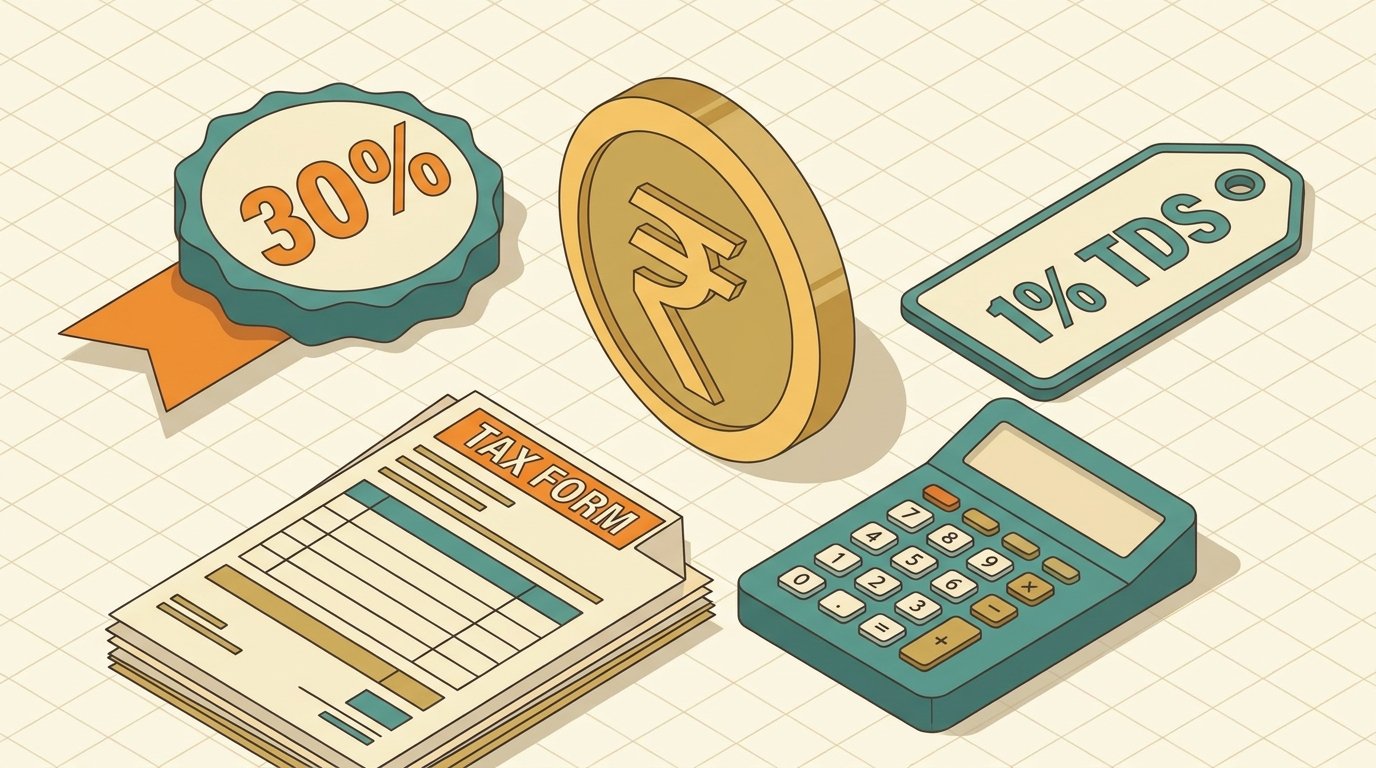
- 30% flat tax on every rupee of profit (plus 4% cess and any surcharge) — no matter your income slab.
- 1% TDS deducted on most sales above ₹50,000 in a year (₹10,000 in certain cases).
- No loss set-off. Lose on one coin, win on another? You still pay full tax on the winner. The loss gives you nothing.
- No deductions beyond your purchase cost — forget 80C-style benefits here.
- You must report everything under Schedule VDA in your ITR.
Let’s make it real. Imagine Ravi, a 28-year-old software engineer in Bengaluru earning ₹90,000/month. He puts ₹1 lakh into crypto. A year later it’s worth ₹1.5 lakh.
His profit is ₹50,000. The taxman wants 30% — that’s ₹15,000 — plus cess. Compare that with an equity mutual fund, where long-term gains up to ₹1.25 lakh a year are tax-free. Same ₹50,000 profit, wildly different take-home.
And from 2026, reporting is tighter than ever — exchanges share data with the tax department, penalties for missed disclosures have gone up, and crypto now sits inside global tax-information sharing too. The “nobody will know” era is over.
The Digital Rupee — India’s Own Crypto Play
Here’s the twist most people miss. While the government taxes private crypto heavily, it is enthusiastically building its own digital currency: the Digital Rupee (e₹).
The Digital Rupee is a CBDC — a central bank digital currency issued by the RBI. Unlike Bitcoin, it is legal tender, fully backed by the government, and worth exactly one rupee. No price rollercoaster.
The RBI is already routing parts of welfare payments and farm subsidies through the e₹ in pilot programmes, and linking it to UPI so you can pay with a familiar QR code.
So India’s real message is clear: private crypto = speculative asset; Digital Rupee = everyday money. Understanding that split tells you exactly where the country is heading. Here’s how the three options really compare:
| Feature | Private Crypto | Digital Rupee (e₹) | Mutual Funds / SIP |
|---|---|---|---|
| Backed by | Market demand only | RBI & Government | Companies / bonds |
| Legal tender? | No | Yes | No |
| Price stability | Very volatile | Always ₹1 | Long-term growth |
| Tax on gains | Flat 30% + cess | N/A (it’s money) | Capital gains rules |
| Regulated by | Lightly (taxed as VDA) | RBI | SEBI |
| Best for | Tiny high-risk bets | Everyday payments | Long-term wealth |
What the Future of Cryptocurrency in India Actually Looks Like
Nobody has a crystal ball. But the direction becomes readable when you watch the signals instead of the hype tweets.
Expect more regulation, not a ban. Ministers have repeatedly said India wants to regulate, not outlaw, private digital assets. A long-awaited discussion paper on rules for things like DeFi and staking is expected to add clarity.
- Sovereign Gold Bonds vs Physical Gold: Which Wins in 2026? Gold is near ₹15,000 a gram and the old SGB advice just changed. Here's an honest,…
- Stop Ignoring This Market: How to Invest in Indian Commodity Markets in 2026 The Indian commodity market is booming — 21 lakh retail users, record gold prices, and landmark…
Expect more reporting and KYC. Exchanges already run strict identity checks. Tax data-sharing is expanding fast. The trend is transparency, not anonymity.
Expect the Digital Rupee to grow for payments while Bitcoin and Ethereum stay parked in the “investment” box. And watch the stablecoin conversation — clearer rules there could unlock cheaper cross-border remittances, something millions of Indian families genuinely care about.
The likely future: crypto stays legal, stays taxed, gets more regulated — and slowly becomes a small, accepted slice of the Indian investing menu rather than a get-rich-overnight casino.
Should You Actually Buy Crypto Right Now? An Honest Take
Let’s be real older-sibling honest with you. Crypto can swing 20% in a day. It can drop 70% in a year. Plenty of coins have gone to zero. This is not an FD.
So before crypto, get the boring stuff right:
- An emergency fund of 6 months’ expenses in an FD or liquid fund.
- Term and health insurance sorted.
- A core of SIPs in index or mutual funds, plus PPF/EPF/NPS for long-term, tax-friendly growth.
Only then, if you still want exposure, treat crypto as a tiny “high-risk” satellite — many advisors suggest no more than 5% of your investable money, and only cash you can fully afford to lose.

Things Nobody Tells You About Crypto in India
Dodge these and you’re already ahead of 90% of beginners.
- Ignoring the 1% TDS drag. Frequent trading means TDS nibbles your capital on every sale. Day-trading crypto in India is brutal on returns.
- Forgetting losses don’t offset. People assume crypto works like stocks. It doesn’t. Plan your taxes before you sell, not after.
- Not reporting in the ITR. With data-sharing now standard, skipping Schedule VDA is a fast track to a tax notice.
- Chasing “100x” meme coins from Telegram tips. Most are exit-liquidity traps. If a stranger is begging you to buy, ask who’s selling.
- Keeping everything on one exchange with a weak, reused password. Turn on 2FA and understand custody before you go big.
- Investing borrowed money or EMIs. Never. A volatile asset plus a fixed monthly EMI is how people get financially wrecked.
Your 7-Day Crypto Action Plan
Want to move from confused to confident this week? Do exactly this:
- Day 1: Check your foundation — is your emergency fund and insurance in place? If not, crypto waits.
- Day 2: Decide your maximum crypto allocation (a strict 5% or less of investable savings) and write it down.
- Day 3: Learn the basics of Bitcoin and Ethereum from neutral sources — skip the “guru” influencers selling courses.
- Day 4: Pick a reputable, KYC-compliant Indian exchange and finish verification properly.
- Day 5: Understand the 30% tax + 1% TDS math so there are zero surprises at ITR time.
- Day 6: Start tiny — even ₹500–₹1,000 — just to learn the mechanics without risking real money.
- Day 7: Switch on 2FA, save your tax records, and set a calendar reminder to review in 3 months. No daily price-checking.
Frequently Asked Questions
Is cryptocurrency legal in India in 2026?
Yes. You can legally buy, hold and sell crypto in India. It just isn’t legal tender, so you can’t officially pay for goods with it, and it’s classed as a Virtual Digital Asset — not as money or a regulated security.
How is crypto taxed in India?
Profits are taxed at a flat 30% (plus 4% cess and any surcharge), with a 1% TDS on most sales. You can’t set off crypto losses against gains, and you must report everything under Schedule VDA in your ITR.
Is the Digital Rupee the same as Bitcoin?
No. The Digital Rupee (e₹) is issued by the RBI, is legal tender, and always equals one rupee. Bitcoin is a private, volatile asset with no government backing. They’re built for completely different purposes.
Will crypto be banned in India?
An outright ban looks unlikely. Officials have repeatedly favoured regulating private crypto rather than banning it, while heavily promoting the Digital Rupee. The realistic future of cryptocurrency in India is tighter rules, not prohibition.
How much should a beginner invest in crypto?
Only money you can fully afford to lose — many advisors suggest capping crypto at 5% or less of your investable portfolio, and only after your emergency fund, insurance and SIPs are sorted.

The Bottom Line
Here’s the honest truth: the future of cryptocurrency in India is neither “everyone gets rich” nor “it all gets banned.” It’s somewhere in the messy, regulated middle — legal, heavily taxed, and slowly maturing.
That’s actually good news for you. You don’t need to gamble your salary on the next meme coin. You can build real wealth the boring, proven way — SIPs, PPF, index funds — and keep crypto as a tiny, well-understood experiment on the side.
Stay curious, stay sceptical, and never invest money you can’t afford to lose. The smartest investors aren’t the loudest — they’re the calmest.
Ready to build a stronger foundation first? Explore our guides on starting your first SIP, PPF vs mutual funds, and filing your ITR the right way on IndiFinance.