
Written and edited by Chandan Bhattacharjee
Editor, IndiFinance | MBA, Economics (Hons.) | Indian | Writes & Teaches Finance, Marketing, Business, Technology & AI
Independent editorial. No paid placements.
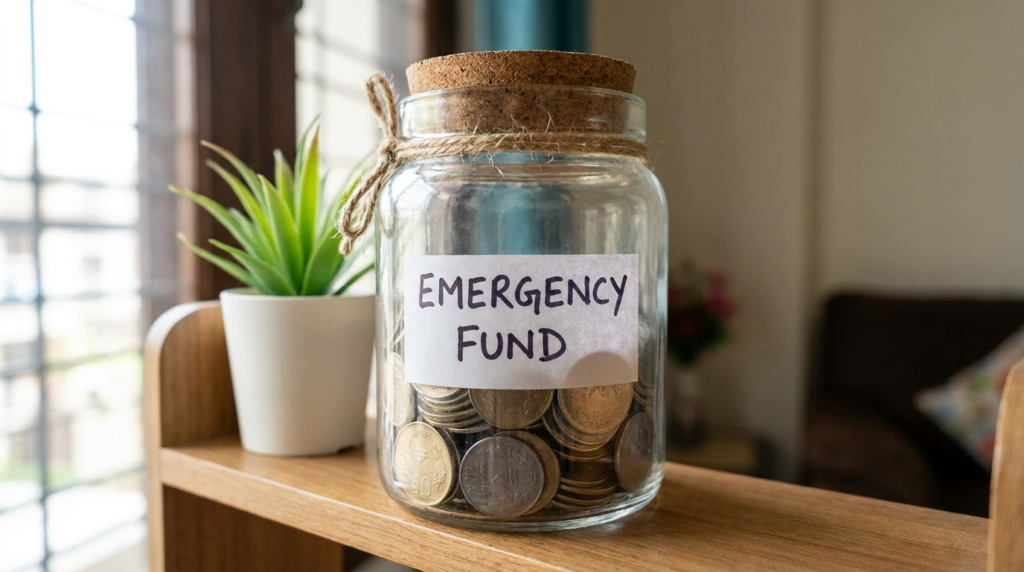
Table of Contents
Emergency Fund India: How Much You Really Need — and Where to Keep It in 2025
Why Most Indians Are One Crisis Away From Financial Ruin
Here’s a number that should keep you up at night: 78% of Indian households have less than one month of savings as a financial cushion, according to a 2023 RBI household finance survey.
Not three months. Not six. One.
Now think about what happened in the last five years alone — a global pandemic that wiped out jobs overnight, mass layoffs in tech, skyrocketing medical costs, and a world economy that economists describe as “fragile” at best. The people who survived those shocks without going into debt or selling investments at a loss had one thing in common: an emergency fund.
This article will show you exactly how big your emergency fund needs to be (it depends on your job), the three best places to park it in India, and how to build one even if you’re starting from zero. By the time you’re done reading, you’ll have a clear action plan — not just vague advice.
What Exactly Is an Emergency Fund?
An emergency fund is a dedicated pool of money set aside only for genuine financial emergencies — not vacations, not a new phone, not a “great deal” on a TV.
Think of it as the financial equivalent of a spare tyre in your car. You don’t drive expecting to get a flat. But the day you do, you’re incredibly grateful it’s there.
The core idea is simple: life throws curveballs. A job loss. A sudden hospitalisation. A major car breakdown that you can’t postpone. Without a safety net, you have two painful options — swipe the credit card (hello, 36% annual interest) or liquidate your investments at exactly the wrong time.
An emergency fund solves both problems. It’s not invested in the stock market. It’s not locked in a 5-year FD. It’s liquid, safe, and boring — which is exactly the point.
Pro Tip: An emergency fund is not the same as your savings. It is separate, untouchable money that exists only for one purpose: protecting you when your income disappears or an unexpected expense appears.
How Big Should Your Emergency Fund Be?
This is the question everyone gets wrong. The answer isn’t a fixed number. It’s a formula:
Your monthly essential expenses × the right number of months
The “right number of months” depends on your employment situation.
For Salaried Employees in Stable Jobs
If you work at a company with reasonable job security, 3 to 4 months of expenses is your target. The logic here is simple: most salaried professionals in India can find a new job within 2–3 months if they lose their current one, so a 3-month buffer gives you breathing room without tying up too much money in a low-yield account.
For Freelancers and Self-Employed Professionals
This category needs a bigger cushion — 6 to 9 months. Why? Because your income is irregular by nature. A bad month doesn’t mean a crisis. But three bad months with zero savings? That’s when panic sets in and bad financial decisions get made. If you’re a freelancer, consultant, or small business owner, your emergency fund is your income stability.
For Single-Income Families
Here’s the most important — and most overlooked — category. If your household runs on one salary, your emergency fund target jumps to 9 to 12 months. A single-income family has no backup if that income disappears. The financial shock is immediate and total. A larger fund gives the family time to regroup, adjust expenses, and find a solution without desperate decision-making.
What Counts as “Monthly Expenses”?
This is critical. You’re counting essential expenses only — not your Netflix subscription or your Saturday dining-out habit. Essential expenses include:
- Rent or home loan EMI
- Groceries and utilities
- School fees
- Health insurance premiums
- Loan EMIs (all of them)
- Basic transport costs
Add those up. That’s your monthly base. Multiply by 3, 6, or 12 depending on your category. That’s your emergency fund target.
A quick example: Rohan is 32, salaried, and his essential monthly expenses are ₹45,000. His target emergency fund = ₹45,000 × 4 = ₹1,80,000. Simple.
The 4 Best Places to Keep Your Emergency Fund in India
This is where most people go wrong — either keeping emergency money in investments (which can crash just when you need them most) or leaving it all in a zero-interest savings account for years.
The ideal emergency fund home has three qualities: safe principal, instant or near-instant access, and some returns to beat inflation.
Here are the four best options in India, ranked by accessibility.
1. High-Yield Savings Account
The simplest option. Keep 1 month’s worth of expenses in your savings account for absolute instant access. Major banks like HDFC, ICICI, and Kotak now offer savings rates of 3–4%, while small finance banks like AU and JANA offer up to 7% on savings accounts. The money is available 24/7, covered under DICGC insurance up to ₹5 lakh, and requires zero paperwork to access.
Best for: The first layer of your emergency fund — the money you’d need in the next 24 hours.
2. Liquid Mutual Funds
Liquid funds invest in very short-term government and corporate debt instruments. They’ve historically returned 6–7% per annum — significantly better than a regular savings account. Redemptions are processed within T+1 working day, meaning the money hits your bank account the next business day.
Top options in India include Parag Parikh Liquid Fund, HDFC Liquid Fund, and ICICI Prudential Liquid Fund. Since the 2019 SEBI reforms, liquid funds can only invest in instruments with maturity up to 91 days — making them very low risk.
Best for: The bulk of your emergency fund (2–3 months’ worth).
3. Sweep-In Fixed Deposit
A sweep-in FD is one of the smartest and most underused products in Indian banking. Here’s how it works: you link a fixed deposit to your savings account. Your money earns FD interest rates (currently 6.5–7.5% for most banks). But if your savings account balance falls below a threshold — say, during an emergency — the bank automatically “sweeps in” money from the FD to cover the shortfall. No penalty, no paperwork.
HDFC, SBI, ICICI, and most major banks offer this product. It takes 15 minutes to set up and is one of the best kept secrets in personal finance.
Best for: People who want the returns of an FD with the accessibility of a savings account.
4. Overnight Funds
Slightly less popular than liquid funds, overnight funds invest only in securities that mature the next day. Their returns are slightly lower (around 5.5–6.5%) but the risk is essentially zero because the portfolio turns over every 24 hours. This makes them an excellent option for extremely risk-averse investors or for the portion of the emergency fund meant for very short-term needs.
What Counts as a Real Emergency — And What Doesn’t
This section might be the most important one in the entire article. The emergency fund fails if you dip into it for the wrong reasons.
Real emergencies — use the fund:
- Sudden job loss or salary cut
- A medical expense not covered by insurance
- Critical home repairs (leaking roof, broken water pump — things you can’t live without)
- A family emergency requiring urgent travel
- A natural disaster that damages your property
NOT emergencies — do NOT use the fund:
- A sale on electronics or a new smartphone
- A vacation (even a “really good deal” on flights)
- A business investment opportunity
- Paying off a credit card balance (unless the interest is genuinely crushing you)
- A new car or home upgrade
The mental model is simple: ask yourself, “If I don’t spend this money right now, will my basic life be physically disrupted?” If the answer is no, it’s not an emergency.
5 Deadly Mistakes People Make With Their Emergency Fund
Most people who have an emergency fund are still making these errors.
1. Keeping it all in one place. Putting ₹3 lakh in a savings account sounds fine until your bank’s app crashes at midnight and you need money right now. Split it: 1 month in savings, the rest in liquid fund or sweep-in FD.
2. Counting investments as an emergency fund. Your mutual fund SIPs, stocks, or PPF are NOT your emergency fund. Markets crash exactly when jobs are at risk — recessions hit both employment and investments at the same time. Never conflate the two.
3. Setting a target once and never updating it. If your expenses go up — you got married, had a child, took a bigger loan EMI — your emergency fund target must go up too. Revisit it every 12 months.
- No Cosigner? No Problem: How International Students Actually Get US Student Loans No US relative to cosign your loan? Here's the real, lender-by-lender breakdown of how international students…
- The 401(k) Match: How Skipping ‘Free Money’ Quietly Costs You Six Figures One in four workers skip part of their 401(k) match — handing away a guaranteed return.…
- Roth vs. Traditional IRA: The Quiet Decision That Changes Everything Roth or Traditional IRA? It feels like a tiny box to tick when you open an…
- US Student Visa in 2026: What Every Indian Applicant Must Know Before Applying F-1 visa rejections for Indian students hit 61% in 2026. Learn how the India-US trade reset,…
4. Being too stingy with the target. People often round down their expenses to feel better about their fund size. Be honest. If you actually spend ₹60,000 a month, don’t tell yourself ₹40,000 is your real monthly need.
5. Using the fund and not refilling it. This is the most common mistake. You use ₹80,000 from the fund for a medical bill. You breathe a sigh of relief. And then you never top it back up. Your emergency fund is only useful if it’s full. Treat rebuilding it as a mandatory EMI.
How to Build Your Emergency Fund From Zero — Step by Step
Don’t have a fund yet? Here’s how to build one without overwhelming yourself.
Step 1: Calculate your target. Use the formula above. Monthly essentials × 3, 6, or 12 depending on your job type. Write the exact number down.
Step 2: Open a dedicated account. Create a separate savings account or liquid fund account that is only for the emergency fund. Do not mix it with your spending account. Psychological separation is important — what you can’t easily see, you can’t easily spend.
Step 3: Set up an automatic transfer on salary day. This is non-negotiable. The same day your salary hits, an auto-transfer of a fixed amount should move to the emergency fund account. Even ₹5,000 per month adds up to ₹60,000 in a year.
Step 4: Start with one month. Don’t be paralysed by the idea of saving 6 months’ worth. The first goal is simply one month. Get there. Celebrate. Then aim for the next month.
Step 5: Use windfalls strategically. Bonus? Tax refund? Got a gift? Put 50% of any windfall directly into the emergency fund until you hit your target. The other 50% can go wherever you like guilt-free.
Step 6: Automate, then ignore. Once the fund is set up with an auto-debit, stop thinking about it. Don’t check returns obsessively. Don’t tinker. The purpose of this money is security, not growth.
Step 7: Review and refill annually. Every April — the start of the Indian financial year — revisit two numbers: your current monthly expenses (has anything changed?) and your fund balance. Adjust and refill as needed.
Step 8: Add health insurance. An emergency fund and health insurance are a team. A good health insurance policy (₹10–15 lakh sum insured) means you won’t need to dip into your fund for most medical bills. [INTERNAL LINK: “How to Choose the Best Health Insurance in India”]
Priya’s Story: How One Fund Changed Everything
Priya is 29. She works as a graphic designer at a mid-size agency in Bangalore. In January 2023, her company announced layoffs. She was let go on a Tuesday with two months’ salary as severance.
Here’s what she had going for her: 5 months of expenses saved in a liquid mutual fund — approximately ₹2.4 lakh. She had built it over 22 months by auto-transferring ₹8,000 every month, barely noticing it was gone.
What happened next? She took four weeks off deliberately. She upgraded her portfolio. She was selective about her next role. She joined a better company three months later at a 30% salary hike.
What would have happened without the fund? She likely would have accepted the first offer that came along — any offer — out of desperation.
The emergency fund didn’t just save her financially. It protected her from making a panicked career decision that could have set her back years.
That is the real value of an emergency fund. It buys you time. And time, in a crisis, is everything.
Why Global Uncertainty Makes This Even More Urgent Right Now
The world in 2025 is not the world of 2019. Global supply chains are still fractured. Interest rates remain elevated in developed markets. Geopolitical tensions — from the Middle East to Taiwan — create unpredictable ripple effects on Indian IT exports, foreign investment flows, and rupee stability.
Closer to home: Indian IT companies went through two consecutive rounds of layoffs in 2023 and 2024. The startup funding winter dried up rapidly, affecting hundreds of thousands of employees. Even PSU bank employees — long considered bulletproof jobs — are seeing restructuring.
The lesson from all this: job stability is an illusion for a much wider group of people than it was a decade ago. The salaried employee who thought they were safe in 2022 knows better in 2025.
An emergency fund isn’t a “nice to have” in this environment. It’s infrastructure. Just like you wouldn’t live in a building without a fire exit, you shouldn’t live a financial life without a safety net.
FAQ
Q: How much emergency fund is enough for a salaried person in India?
A: For a salaried employee with a stable job, 3 to 4 months of essential monthly expenses is generally sufficient. If you have dependents or a single-income household, aim for 6 to 9 months for greater security.
Q: Should I invest my emergency fund in mutual funds?
A: Only liquid mutual funds or overnight funds are appropriate for emergency money. Equity mutual funds, ELSS, or any market-linked product are NOT suitable — their value can fall exactly when you need the money most. Liquid funds combine decent returns with T+1 redemption access.
Q: Can I use a sweep-in FD as an emergency fund in India?
A: Yes, a sweep-in FD is one of the best emergency fund vehicles in India. It earns FD-level interest (6.5–7.5%) while automatically making funds available in your savings account when needed. It combines accessibility and returns better than a plain savings account.
Q: What is the difference between emergency fund and savings?
A: Your savings can have many goals — buying a car, a vacation, a down payment. An emergency fund has exactly one purpose: financial survival during an unexpected crisis. It should be separate, not invested in volatile assets, and never touched for non-emergencies.
Q: How do I rebuild my emergency fund after using it?
A: Treat the rebuild like a mandatory expense. Set up an automatic transfer for a fixed amount every month — even ₹5,000 — until the fund is back to its target. Allocate 50% of any bonus or windfall to this goal until it’s restored.
Q: Should my emergency fund include my PPF or EPF balance?
A: No. PPF has a 15-year lock-in with very limited withdrawal windows. EPF withdrawal is possible but takes 7–10 days and has tax implications. Neither is suitable as an emergency fund. Keep your emergency fund in liquid, instantly accessible instruments.
Final Takeaways
Here are the three things to walk away with:
1. Calculate your number today. Take your essential monthly expenses. Multiply by 3 (salaried), 6 (freelancer), or 12 (single-income family). That is your target. Write it down right now.
2. Split it across two buckets. Keep 1 month in your savings account for instant access. Park the rest in a liquid mutual fund or sweep-in FD for better returns while maintaining accessibility.
3. Automate and protect it fiercely. Set up an auto-transfer. Do not touch it for anything that doesn’t genuinely threaten your ability to pay rent or feed your family. Refill it the moment you use it.
In a world of economic uncertainty, an emergency fund is the single most powerful thing you can do for your financial health before investing a single rupee in the stock market. It isn’t glamorous. It won’t go viral on Twitter. But it is the quiet foundation that everything else — your SIPs, your goals, your ambitions — is built on.
Found this helpful? Share it with someone who needs to hear this. It might be the most useful thing you do for their finances today.
Disclaimer: This article is for educational purposes only and does not constitute financial advice. Please consult a SEBI-registered financial advisor for personalised guidance.