
Written and edited by Chandan Bhattacharjee
Editor, IndiFinance | MBA, Economics (Hons.) | Indian | Writes & Teaches Finance, Marketing, Business, Technology & AI
Independent editorial. No paid placements.
You open your app. You tap the green Buy button. One second later: Order executed.
Congratulations. You now own a slice of a company worth thousands of crores. Just like that.
But here is the part nobody tells you about what happens when you buy a stock: in that single second, your order sprinted through four different organisations, got matched with a total stranger, and kicked off a chain that will not fully finish until tomorrow.
Let us open the hood and watch it happen in slow motion. By the end, you will understand your own money better than 95% of the people in your WhatsApp investing group.

Why this suddenly matters for every Indian investor
India now has well over 18 crore demat accounts. A huge chunk belong to people under 35. Most opened their first account during or after the pandemic, straight from a phone, in under ten minutes.
That is genuinely beautiful. But it also means crores of us are clicking Buy without any idea of what is happening behind the screen. And what you do not understand, you tend to either fear or blindly trust. Neither is good for your money.
Understanding the plumbing will not make you rich overnight. But it will stop you from panicking on a red day, overpaying on a bad order, or getting fooled by a slick Telegram tip. So let us go.
What happens when you buy a stock: the one-second tour
Meet Ananya, a 27-year-old designer in Pune. She earns ₹65,000 a month, has a small SIP running, and today she wants to buy 10 shares of a company trading at ₹500. Total: ₹5,000.
She taps Buy. Here is the relay race her order runs, all before she can even put her phone back in her pocket:
- Her broker receives the order and frisks it in milliseconds.
- The stock exchange (NSE or BSE) matches it with a willing seller.
- The clearing corporation steps into the middle as guarantor.
- The depository (CDSL or NSDL) parks the shares in her demat account.
Four players. One tap. Let us meet each one properly.
Step 1: Your tap leaves the phone (and gets frisked)
The moment Ananya hits Buy, her order zips to her broker, whether that is Zerodha, Groww, Upstox, Angel One or any other SEBI-registered name she signed up with.
The broker does not just forward it blindly. In milliseconds it runs checks. Does she have the ₹5,000 in her account? Is this a real, tradable stock? Is the market open? Is she attempting something the rules do not allow? Is the order type valid?
If everything is clean, the broker pushes her order to the exchange tagged with a unique ID. Think of your broker as the licensed gatekeeper between you and the actual market. You cannot walk into the NSE and shout your order yourself. Your broker is your authorised entry pass, and that is exactly why you trade through one.
Step 2: The matching engine plays matchmaker
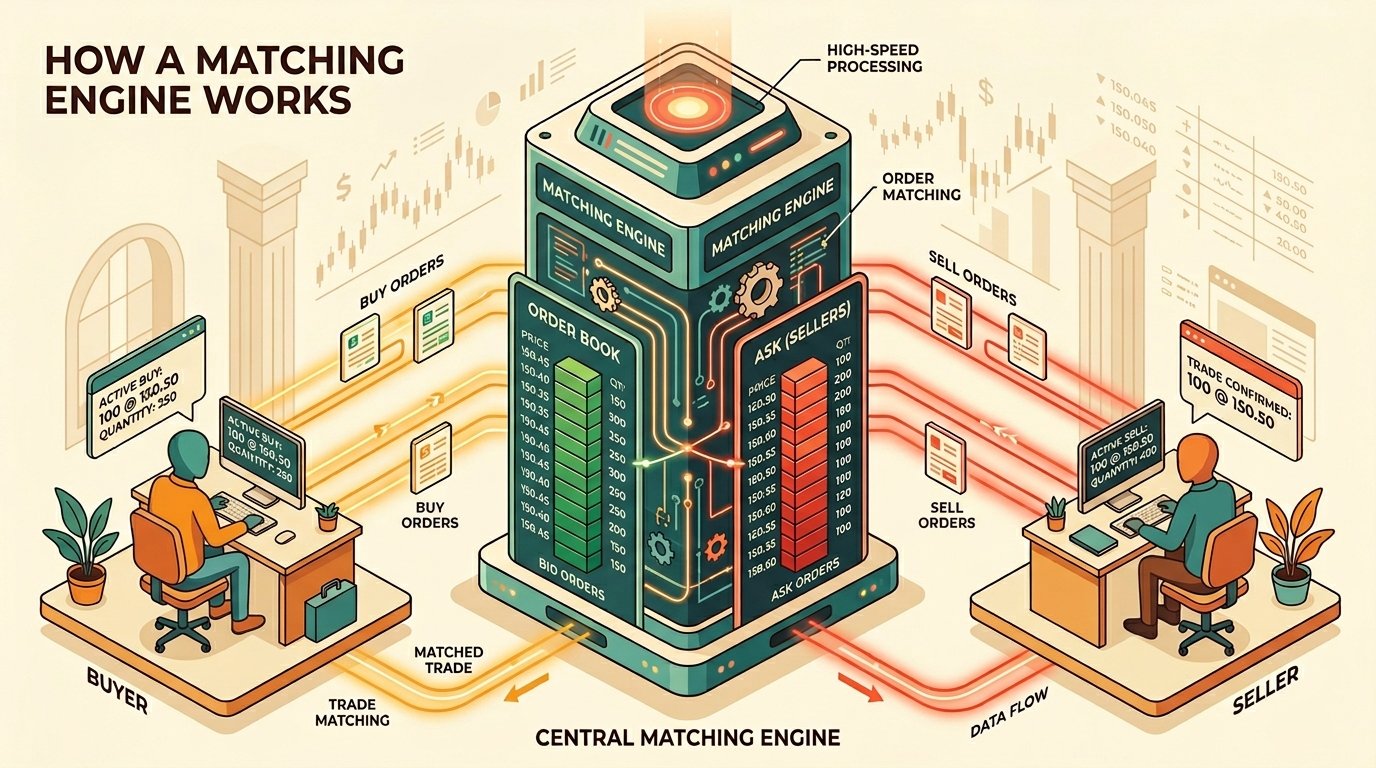
Now Ananya’s order lands inside the exchange’s order book, which is a giant live list of every person wanting to buy and every person wanting to sell that exact stock, right at this second.
The exchange runs a blistering supercomputer called the matching engine. Its only job is to pair buyers with sellers using two simple rules: best price gets priority, and when prices tie, whoever placed the order first wins.
So somewhere out there, a man named Rohit wants to sell 10 shares at ₹500. Ananya wants to buy 10 at ₹500. The engine spots the match and, snap, the trade is done in microseconds. Neither of them knows the other exists. That is the quiet genius of a modern stock market.
The ‘price’ you see on screen is not set by the company. It is simply the last price at which a buyer and a seller agreed. Millions of these tiny handshakes happen every second, and together they become the price.
This is also why you sometimes see a small gap between the buy price and the sell price, called the bid-ask spread. On a hugely traded stock that gap is tiny. On a thinly traded small-cap, it can be wide, and that gap quietly comes out of your pocket.
Who is actually on the other side of your Buy?
Here is something most beginners never think about. When you buy, somebody is selling to you at that exact instant. Who?
It could be another retail investor like you booking profits. It could be a giant mutual fund rebalancing, a foreign investor (FII) pulling money out, or an institution trimming a position. You will never know, and you do not need to.
The takeaway is humbling and useful: every trade has two confident humans on opposite sides, each sure they are making the smart move. One of them is usually wrong. That is precisely why discipline and research beat impulse and hype over the long run.
Step 3: The middleman who makes sure nobody gets cheated
Now a scary thought. What if Rohit grabs the money but never hands over the shares? Or Ananya receives the shares and quietly refuses to pay?
This is where the clearing corporation walks in, NSE Clearing Ltd for the NSE and Indian Clearing Corporation for the BSE. The instant the trade is matched, it legally steps into the middle and becomes the buyer to every seller and the seller to every buyer.
So Ananya is not really trusting Rohit, a stranger she will never meet. She is trusting the clearing corporation, which guarantees the trade will settle no matter what, backed by a settlement guarantee fund and strict margins collected upfront.
- Investing in US Stocks? 8 Things to Learn Before You Start Thinking about investing in US stocks but not sure where to begin? Here are the 8…
- The Indian Stock Market in 2026: What Smart Investors Are Quietly Doing While Everyone Panics Sensex fell from 83,000 to 74,000 in months, FIIs pulled over ₹2 lakh crore, yet quiet…
- What is a Share/Stock? A Simple Explanation Written and edited by Chandan Bhattacharjee Editor, IndiFinance | MBA, ... Read more
- What is the Stock Market? Written and edited by Chandan Bhattacharjee Editor, IndiFinance | MBA, ... Read more
This single mechanism is the reason the Indian stock market feels safe enough for a first-timer with just ₹500 to take part on the same terms as a fund manager moving ₹500 crore.
Step 4: T+1, when the shares actually become yours
Your app screams ‘executed’ instantly, but the shares do not physically move that same second. They settle on a T+1 cycle, meaning Trade day plus one working day.
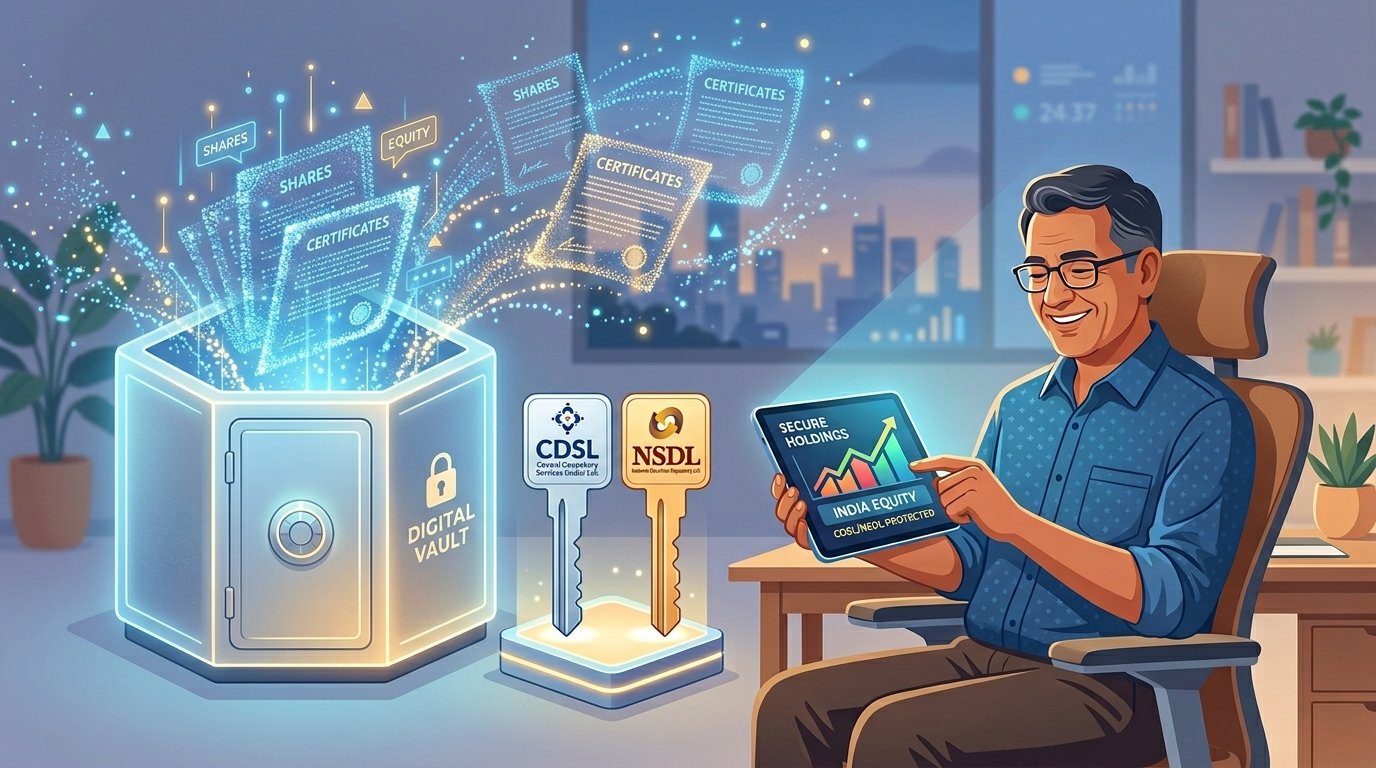
So if Ananya buys on Monday, the 10 shares get credited to her demat account, held electronically by CDSL or NSDL, by Tuesday evening. The money leaves her account and reaches Rohit in the same window. Until then she legally owns the shares from trade day, even though they are still in transit.
India is a genuine global leader here. We moved to T+1 in January 2023, ahead of the United States, which only caught up in 2024. SEBI has since rolled out an optional T+0 same-day settlement for the top 500 stocks, and in 2026 is piloting near-instant settlement powered by UPI. The gap between Buy and owned is shrinking towards zero.
| Stage | What happens | When |
|---|---|---|
| Order placed | You tap Buy | Instant |
| Trade executed | Matched with a seller | Microseconds |
| Clearing | Obligations and margins calculated | Same day |
| Settlement (T+1) | Shares hit your demat, money reaches seller | Next working day |
The charges hiding behind that green button
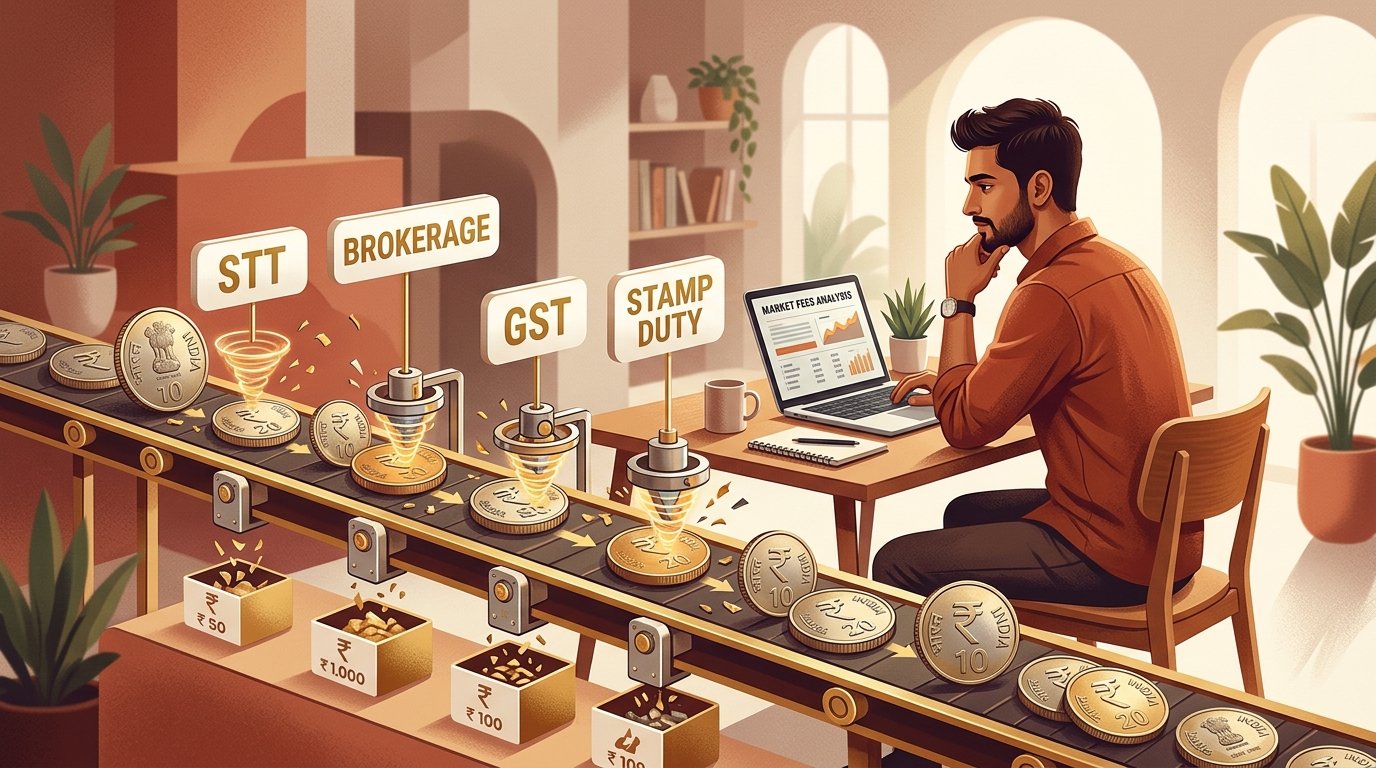
That ₹5,000 trade is not exactly ₹5,000. A handful of small charges ride along quietly, and most beginners never notice them until they read a contract note carefully.
For a delivery purchase, here is roughly what stacks up on a ₹50,000 buy. Figures are illustrative and vary by broker and state.
| Charge | On a ₹50,000 buy | Who takes it |
|---|---|---|
| Brokerage | ₹0 to ₹20 | Your broker |
| STT (0.1%) | about ₹50 | Central government |
| Exchange transaction charge | about ₹1.5 | NSE or BSE |
| Stamp duty (0.015%) | about ₹7.5 | State government |
| GST (18% on fees) | about ₹4 | Government |
| SEBI turnover fee | a few paise | The regulator |
On one trade it looks trivial. But if you are a hyperactive trader doing dozens of trades a month, these charges quietly chew through your returns, and that is before you even count taxes. If you want the full picture of how stocks are taxed, it is worth a separate read. This cost drag is one big reason patient long-term investing usually beats frantic trading. Fewer clicks, fewer charges, more wealth left for you.
Market order vs limit order: the setting that quietly costs you
When you tap Buy, you usually choose between two main order types, and plenty of beginners pick the wrong one without realising.
- Market order: ‘Buy it now at whatever the going price is.’ It is fast and almost always fills, but on a volatile or low-volume stock you might pay noticeably more than the price you saw.
- Limit order: ‘Buy only at ₹500 or lower.’ You control the price, but the trade may never execute if the stock does not touch your number.
A simple rule of thumb: for big, heavily traded stocks, a market order is usually fine. For smaller, jumpy stocks, a limit order shields you from nasty surprises. That one quiet choice can save you real money across a year of trades.
Common mistakes nobody warns you about
- Confusing executed with settled. You own the shares from trade day, but they reflect in your demat on T+1. Do not panic if you do not see them on day one.
- Firing market orders on illiquid stocks. With very few sellers, you can badly overpay in a split second.
- Ignoring charges on frequent trades. Twenty small trades a month can bleed you slowly without you noticing.
- Chasing tips from Telegram and YouTube. The matching engine does not care about hype. Some operators do, and you are the exit they are waiting for.
- Trading through someone else’s account. Always use your own SEBI-registered broker and your own demat. Shortcuts here are how people lose everything.
Your 7-day action plan
- Day 1: Open your broking app and pull up the contract note or charges page for any past trade. Read every single line.
- Day 2: Find out whether your demat sits with CDSL or NSDL. It is printed in your account details.
- Day 3: Place one tiny limit order, say ₹500 worth, and watch how it waits patiently in the order book until it fills.
- Day 4: Track that trade into the next day and confirm the shares actually land in your demat on T+1.
- Day 5: Compare a market order and a limit order on the same liquid stock and note the price difference.
- Day 6: Add up your total charges and work out what percentage of your trade they ate.
- Day 7: Decide your style, long-term investor or active trader, now that you know exactly what each click really costs.
Frequently asked questions
Do I own the share the moment I click Buy?
Legally, yes. Your ownership is locked in on trade day itself. But the shares physically appear in your demat account on the next working day under India’s T+1 settlement system. So you own them before you can see them.
Where are my shares actually kept?
In electronic form with a depository, either CDSL or NSDL. Your broker is only the gateway. The depository is the secure locker that holds your shares in your own name, which is why your shares are safe even if your broker has problems.
What if the seller never delivers the shares?
You are protected. The clearing corporation guarantees the trade and runs an auction to source the shares if a seller defaults. You are trusting the system, not a stranger, and that is the whole point of the design.
Why does my buy price differ slightly from the price I saw?
If you used a market order, the price can shift in the split second between your tap and the match, especially on volatile or thinly traded stocks. A limit order avoids this completely by fixing the maximum you are willing to pay.
Is buying stocks in India safe for beginners?
The infrastructure is among the safest in the world, thanks to SEBI regulation, guaranteed settlement and demat custody. The real risk is not the plumbing. It is poor decisions, hype-buying and skipping research. Master those and you are most of the way there.
The bottom line
Now you know exactly what happens when you buy a stock. One tap, four institutions, a stranger on the other side, and a guarantee system quietly making sure nobody gets cheated.
That green button is not magic. It is a beautifully engineered machine built over decades, and it works just as hard for your ₹500 as it does for a fund manager’s ₹500 crore. The market does not check your bank balance before treating you fairly.
So invest with intention, not impulse. Understand the click before you make it, keep your costs low, ignore the noise, and let time do the heavy lifting.
Ready to go deeper? Explore our guides on choosing the right demat account, order types explained, starting your first SIP and what is a stock, and turn that single click into a lifelong wealth habit.