
Written and edited by Chandan Bhattacharjee
Editor, IndiFinance | MBA, Economics (Hons.) | Indian | Writes & Teaches Finance, Marketing, Business, Technology & AI
Independent editorial. No paid placements.
You showed up to work. You did the job. And your company offered to hand you thousands of extra dollars a year — no strings, no catch.
And one in four people quietly say… no thanks.
That is the 401k match in a nutshell: the closest thing to free money your paycheck will ever see, and millions leave it sitting on the table every single year.
Here is why this matters right now. Most Americans build their entire retirement inside a workplace plan. If you are skipping even part of your match, you are not just losing a few hundred dollars today — you are handing away a six-figure chunk of your future self’s money, and you will not feel the sting until it is far too late to fix it.

What a 401(k) match actually is (and why it is basically free money)
A 401(k) is a retirement account your employer sets up. You contribute a slice of each paycheck before taxes, it gets invested, and it grows for decades.
The match is the magic part. To nudge you to save, many employers promise this: for every dollar you put in, we will add some money too — up to a limit.
Think of it like a friend saying, ‘For every ₹100 you save, I’ll throw in ₹50.’ You would never say no to that. Yet that is exactly what skipping the match does.
According to Fidelity’s research on the average 401(k) match, the typical plan adds around 4% to 5% of your pay, and roughly nine in ten employers that offer a 401(k) offer some kind of match. This is not a rare perk. For most working Americans, it is sitting right there in the benefits portal, waiting.
And the return is unbeatable. A dollar-for-dollar match is an instant 100% return on your money before the market does anything at all. No stock, no crypto, no real estate deal hands you a guaranteed double on day one.
How the 401k match formulas actually work
Every company writes its own formula, and the wording is where people trip up. Let us decode the three most common ones.
1. Dollar-for-dollar up to a cap. ‘We match 100% of the first 4% you contribute.’ Put in 4% of your salary, your employer adds another 4%. Simple.
2. Partial match. ‘We match 50% of the first 6%.’ Put in 6%, your employer adds 3%. You have to contribute the full 6% just to unlock the maximum 3%.
3. Tiered match. ‘100% of the first 3%, then 50% of the next 2%.’ Contribute 5%, and your employer kicks in 4%.
Here is how those look on an $80,000 salary:
| Match formula | You must contribute | Free money you get |
|---|---|---|
| 100% of first 4% | 4% ($3,200) | $3,200 / year |
| 50% of first 6% | 6% ($4,800) | $2,400 / year |
| 100% of 3% + 50% of next 2% | 5% ($4,000) | $3,200 / year |
The trap hides in that middle column. With a 50%-of-6% plan, contributing only 3% feels responsible — but you are quietly leaving half the match unclaimed.
The six-figure math: how a tiny gap becomes a giant hole
This is where ‘a few hundred bucks’ turns genuinely scary. Compounding does the damage.
Meet Arjun, a 29-year-old product designer in Austin earning $90,000. His company matches 50% of the first 6%. To grab the full match he needs to contribute 6% ($5,400), and the company adds 3% ($2,700).
But Arjun, juggling rent and student loans, sets his contribution at 3%. So the company adds only 1.5% — about $1,350. He is leaving $1,350 of free money on the table every single year.
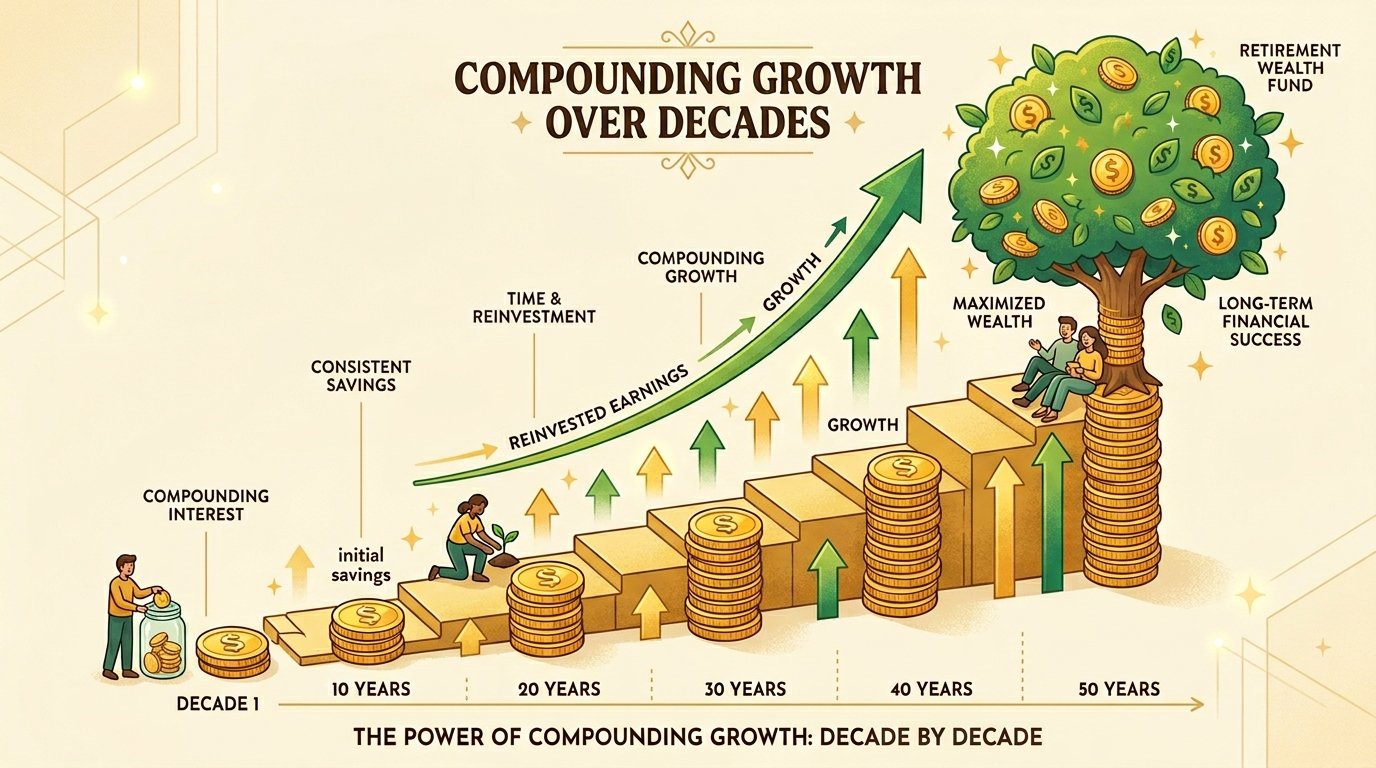
Sounds small. Now compound it. Invested over 30 years at a 7% average return, that missed $1,350 a year grows to roughly $128,000. That is a home down payment, a child’s college fund, or years of freedom — gone, because a slider was set to 3 instead of 6.
And Arjun is not unusual. One widely cited study found Americans leave around $24 billion in unclaimed employer match on the table every year, with the typical under-saver giving up about $1,336 annually. Notice how those numbers always seem to land near a six-figure cliff over a full career.
The match is the only part of investing where the return is guaranteed and instant. Everything else is hope. This is math.
Want to see how even small, boring contributions snowball? That is the magic of compounding — and the match supercharges it from day one.
Vesting: the fine print that can claw your match back
Here is the catch almost nobody reads until it is too late. Your own contributions are always 100% yours. The employer’s match, though? Sometimes you have to earn the right to keep it by staying long enough. This is called vesting.
Two common schedules:
- Cliff vesting: you own 0% of the match until, say, year three — then 100% all at once. Leave at month 35 and you may walk away with nothing.
- Graded vesting: you own a growing slice each year — maybe 20% after year one, 40% after year two, and so on — until you are fully vested.
Some plans, especially ‘safe harbor’ ones, vest immediately, so the match is yours from day one.
- No Cosigner? No Problem: How International Students Actually Get US Student Loans No US relative to cosign your loan? Here's the real, lender-by-lender breakdown of how international students…
- Roth vs. Traditional IRA: The Quiet Decision That Changes Everything Roth or Traditional IRA? It feels like a tiny box to tick when you open an…
- US Student Visa in 2026: What Every Indian Applicant Must Know Before Applying F-1 visa rejections for Indian students hit 61% in 2026. Learn how the India-US trade reset,…
- Stop Losing Money to Inflation: 5 Proven Ways to Protect Your Purchasing Power Written and edited by Chandan Bhattacharjee Editor, IndiFinance | MBA, ... Read more
Why this matters: if you are eyeing a new job and you are a few months from a vesting cliff, that match is real money. Sometimes it is worth waiting a quarter to leave with thousands extra in your pocket. Always check your vesting status in the plan documents before you resign.
The 2026 contribution limits you should know
The IRS caps how much you can put in, and for 2026 the numbers went up.
- Employee contribution limit: $24,500 (up from $23,500 in 2025).
- Age 50-plus catch-up: an extra $8,000, for a total of $32,500.
- Ages 60 to 63 super catch-up: an extra $11,250 instead, if your plan allows.
- Combined employee plus employer limit: $72,000.
Two things to remember. First, your employer’s match does not eat into your $24,500 — that cap is for your money alone. Second, you do not need to hit $24,500 to get the full match; you only need to contribute up to your match cap, often 4% to 6% of pay. The full details live on the IRS 2026 contribution limits page.
One sneaky trap: if you ‘front-load’ and max out early in the year, a plan without a year-end true-up can stop matching once you hit your own cap — leaving later match dollars unclaimed. Pace your contributions across all twelve months unless you have confirmed your plan trues up.
What the 401k match means if you are an Indian in the US
If you moved to the US on an H-1B, an L-1, or as a student who turned into a working professional, this part is for you.
The instinct for many of us is to send money home, build something in India, maybe plan to return in a few years. All valid. But here is the thing — the match is free money while you are here. Skipping it to save ‘for India’ usually means losing more than you save.
Even if you eventually move back, your vested 401(k) does not vanish. You can leave it invested, roll it into an IRA, and let it keep growing. Yes, withdrawing early before age 59½ generally triggers tax and a 10% penalty, so you plan around that — but the match you captured is yours.
Think of it as the US cousin of EPF, except the ’employer contribution’ can be a richer, market-linked match. If you are weighing how to split money across borders, our guide for Indians managing money in the US breaks down the full picture.
And before you pour everything into retirement, make sure you build an emergency fund first — three to six months of expenses in cash. The match is brilliant, but locked-up money is no help in a crisis.

Things nobody tells you (common 401(k) match mistakes)
The match is simple in theory and full of quiet traps in practice. Here are the ones that bite hardest.
- Contributing ‘something’ but not enough. Putting in 2% when the cap is 6% feels productive. It is the single most common way people lose half their match.
- Leaving the money in cash inside the 401(k). The match lands in your account, but if it sits in a money-market default and never gets invested, it barely grows. Pick your funds.
- Ignoring fees. A 1% annual fee can quietly eat six figures over a career. Lean toward low-cost index funds when your plan offers them.
- Cashing out when you switch jobs. Taking the lump sum triggers taxes, penalties, and kills decades of compounding. Roll it over instead.
- Forgetting old 401(k)s entirely. Job-hop a few times and it is shockingly easy to leave accounts gathering dust. Track every single one.
- Picking traditional vs Roth on autopilot. Pre-tax now or tax-free later changes your outcome a lot. It is worth a real think — see Roth vs Traditional 401(k).
Your 7-day action plan to grab every dollar
No theory. Here is exactly what to do this week.
- Day 1 — Find your match formula. Log into your benefits portal or HR system and read the exact match wording. Write it down.
- Day 2 — Calculate your match cap. Work out the contribution percentage you need to hit to unlock 100% of the match, often 4% to 6%.
- Day 3 — Check your current contribution. Are you below the cap? If yes, you are losing free money right now.
- Day 4 — Bump your contribution to at least the full match. Even if you cannot afford the IRS max, capture every matched dollar. This one is non-negotiable.
- Day 5 — Confirm the money is invested. Make sure contributions flow into a diversified fund, not a cash default.
- Day 6 — Check your vesting schedule. Know when the match becomes fully yours, especially if a job change is on the horizon.
- Day 7 — Set an auto-escalation. Schedule a 1% increase every year or with every raise. You will not miss money you never saw.
Do this once and it runs on autopilot for decades.
FAQ: your 401(k) match questions answered

What does ‘leaving money on the table’ actually mean?
It means not contributing enough to unlock your full employer match. If your company matches up to 6% but you only contribute 3%, you forfeit the other 3% of match entirely. That unclaimed amount is simply gone — it does not roll over or wait for you.
Should I contribute to my 401(k) even if there is no match?
Often yes, because of the tax advantages and compounding — but the urgency is lower without a match. With no match, also compare an IRA, which usually offers more investment choices. The match is what makes the 401(k) an absolute no-brainer.
How much should I contribute to get the full match?
Exactly up to your plan’s match cap, which is commonly 4% to 6% of your salary. Read your plan’s formula to find the precise number, then set your contribution at or above it.
Does the employer match count toward my $24,500 limit?
No. For 2026, the $24,500 cap applies only to your own contributions. The match sits under a separate, higher combined limit of $72,000, so employer money never reduces how much you personally can put in.
What happens to my match if I quit before I am vested?
You may forfeit some or all of the unvested match, depending on your plan’s vesting schedule. Your own contributions are always 100% yours. Check your vesting status before resigning, especially near a cliff date.
I am an Indian working in the US — is the 401(k) still worth it?
Usually yes. Even if you plan to return to India, the vested match is your money. You can keep it invested or roll it into an IRA and let it grow. Just plan around early-withdrawal taxes and penalties before age 59½.
The bottom line: claim what is already yours
Here is the simplest money rule you will ever read: never walk past free money. The 401k match is your employer offering to invest in your future for you — and all you have to do is show up and tick a box.
Skip it, and the cost is not abstract. It is the six figures your future self quietly never gets to spend. Claim it, and you have just handed yourself a guaranteed raise that compounds for decades.
Go check your contribution percentage today. Then keep building — explore our guides on Roth vs Traditional 401(k) and the magic of compounding to turn that match into real, life-changing wealth.